What is the best hedge for privacy in the UK?
Start with the view you need to block, then consider the space available for the hedge to grow. A dense evergreen is useful for screening throughout winter, but growth rate, soil conditions and the amount of pruning you can manage matter just as much as height. For most UK gardens, cherry laurel and Portuguese laurel offer broad evergreen leaves and rapid establishment, while English yew and holly give a neater, slower-growing screen. Green Leylandii provides the fastest height but demands regular trimming.
Before choosing plants, measure the available width as well as the height you need. A narrow boundary may suit clipped yew or Portuguese laurel, while a wider strip gives cherry laurel room to develop its broad, glossy foliage. A hedge that screens an overlooked patio in summer may not need to be evergreen, while a boundary beside a busy road usually calls for dense foliage all year. Start by measuring the height you actually need from the point where you sit or stand, then work back to the plants that fit the space.
Evergreen hedges for year-round privacy
Evergreen hedging keeps its leaves through winter, so it screens views and provides shelter in every season. The main choices split into broad-leaved evergreens such as laurel and holly, and conifers such as Leylandii and yew. Each group has different growth rates, leaf textures and pruning needs.
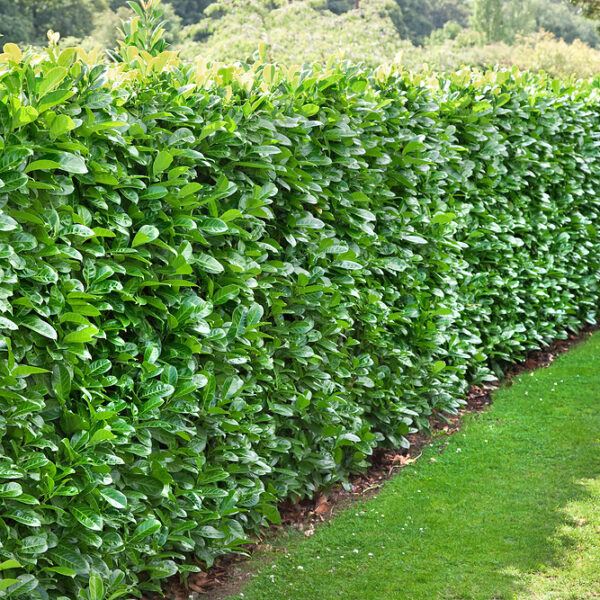
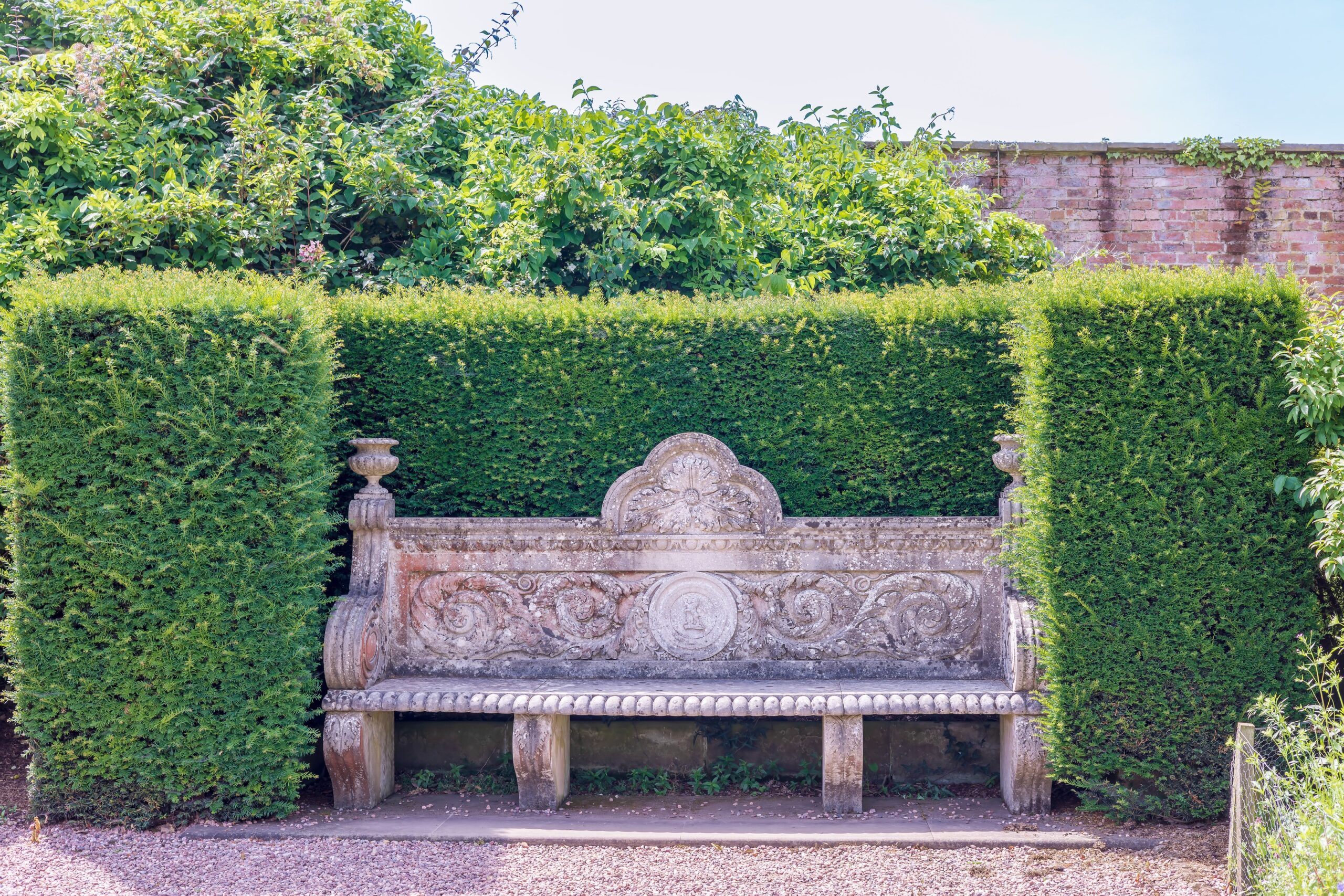
Cherry laurel has large, glossy leaves that create a substantial screen, while Portuguese laurel has smaller leaves and reddish stems that suit a tighter outline. Leylandii forms a dense wall of green when clipped regularly. Yew grows more slowly but tolerates shaping particularly well, making it useful where the hedge needs to remain narrow.
| Species | Evergreen | Growth per year | Eventual hedge height | Spacing per metre | Key maintenance |
|---|---|---|---|---|---|
| Cherry laurel | Yes | 30 to 60cm | 2.5 to 5m | 2 to 3 plants | Trim once or twice a year |
| Portuguese laurel | Yes | 30 to 45cm | 2.5 to 5m | 2 to 3 plants | Trim once a year |
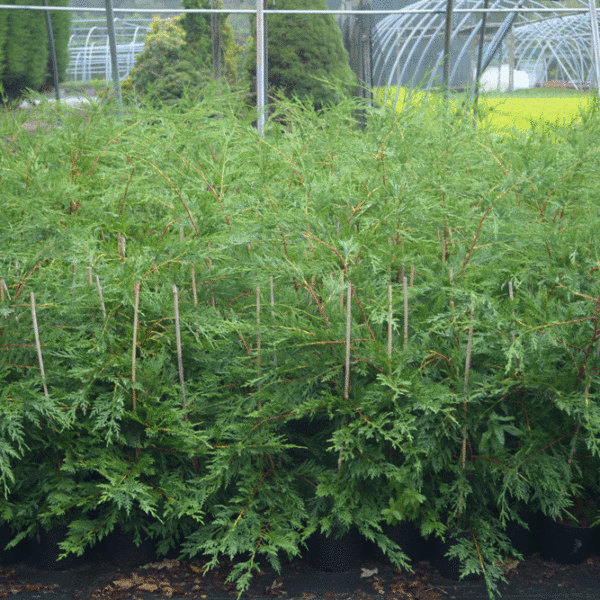
| Green Leylandii | Yes | 60 to 90cm | 3 to 10m+ | 2 to 3 plants | Trim two to three times a year |
| English yew | Yes | 20 to 30cm | 1.5 to 4m+ | 2 to 3 plants | Trim once a year |
| English holly | Yes | 20 to 40cm | 2 to 6m | 2 to 3 plants | Trim once a year |
| Privet | Semi-evergreen | 30 to 60cm | 1.5 to 4m | 3 to 4 plants | Trim two to three times a year |
What is the fastest growing hedge for privacy?
Green Leylandii is the fastest-growing privacy hedge widely planted in the UK, capable of putting on 60 to 90cm of height each year once established. Its dark green foliage soon fills gaps between plants, making it useful along exposed or overlooked boundaries. Plan for two or three light trims each growing season, though, because an established Leylandii hedge can become difficult to control if neglected.
Cherry laurel is the fastest broad-leaved evergreen alternative, adding 30 to 60cm per year. It produces large, glossy leaves that overlap well and create a solid visual block. Both species need enough width to develop properly, so allow at least 60 to 90cm of depth for the mature hedge and plan access for cutting both sides.
What is the easiest hedge to grow for privacy?
Cherry laurel and Portuguese laurel are among the easiest privacy hedges to grow in the UK. They tolerate a wide range of soils, including clay and partial shade, and establish reliably from pot-grown plants. Once the roots are down, they need little attention beyond an annual trim to keep the shape and height you want.
Privet is another forgiving option, particularly for urban or suburban gardens. It grows in most soils, copes with pollution and recovers well from hard pruning. Privet is semi-evergreen, so it may lose some leaves in a cold winter, but it still provides good screening for much of the year and is very straightforward to maintain.
What is the best plant to block neighbours' views?
The best plant to block a neighbour's view depends on the height you need to screen and how quickly you want the result. For an upstairs window overlooking your garden, you often need a hedge that can reach 2.5 to 4m and hold dense foliage at that height. Cherry laurel, Portuguese laurel and Green Leylandii all grow tall enough and can be maintained at the required level with regular trimming.
If the view you want to block is from a ground-floor window or a patio next door, a lower hedge of 1.5 to 2m may be enough. English holly and yew work well at these heights and give a more formal appearance. Holly has the added advantage of spiny leaves, which can discourage people from pushing through the boundary, but it is slower to establish than laurel.
How tall can a hedge be between neighbours?
There is no general legal maximum height for a domestic garden hedge. In England and Wales, the Anti-social Behaviour Act 2003 allows councils to consider complaints about hedges formed predominantly from two or more evergreen or semi-evergreen trees or shrubs over 2m tall, where they interfere with a neighbour's reasonable enjoyment of their home or garden. Different legislation applies in Scotland and Northern Ireland.
If a complaint is upheld, the council can issue a remedial notice requiring you to reduce the height and keep it at a specified level. The best approach is to talk to neighbours before planting and agree a height that works for both sides. Keeping the height agreed with your neighbours and trimming regularly can help prevent disputes. The 2m threshold is not a universal height limit, and a council may set a different permitted height after considering a complaint.
Deciduous and semi-evergreen choices for summer privacy
Not every privacy hedge needs to be fully evergreen. If you mainly use the garden between late spring and early autumn, a deciduous or semi-evergreen hedge can provide excellent screening during those months while letting more light through in winter. Green beech holds its dead brown leaves through winter when clipped as a hedge, giving some cover even in the colder months.
Common hawthorn is a native option that grows quickly, flowers in May and produces red haws in autumn. It makes a dense, thorny barrier that is excellent for security and wildlife. Privet, though often treated as an evergreen, is semi-evergreen and may drop leaves in harsh winters, but it remains the go-to choice for many front and back gardens because it is so easy to manage.
| Species | Foliage type | Growth per year | Eventual hedge height | Spacing per metre | Key feature |
|---|---|---|---|---|---|
| Green beech | Deciduous (holds dead leaves) | 30 to 60cm | 1.5 to 5m | 3 to 4 plants | Russet winter foliage |
| Common hawthorn | Deciduous | 30 to 60cm | 1.5 to 5m | 3 to 4 plants | Flowers and berries |
| Privet | Semi-evergreen | 30 to 60cm | 1.5 to 4m | 3 to 4 plants | Tolerates hard pruning |
Spacing, planting and aftercare for a dense screen
Getting the spacing right is essential for a hedge that fills in evenly without gaps. As a general rule, plant at the wider end of the recommended spacing range if you are using larger, bushier plants, and at the closer end for smaller or bare root plants. A double staggered row can fill out more quickly across the planting strip, although it needs a wider bed and more plants. For the same spacing along each row, two full rows require twice as many plants as one.
Prepare the ground by clearing weeds and improving the soil with organic matter along the whole row. Water thoroughly after planting and keep the soil moist through the first growing season. A mulch of bark or compost helps retain moisture and suppress weeds. Bare root plants, generally available from November to March, should be planted promptly while dormant. Keep the roots covered and moist until they are in the ground, and avoid planting into frozen or waterlogged soil.
| Hedge length | Plants needed (2 per metre) | Plants needed (3 per metre) | Plants needed (4 per metre) |
|---|---|---|---|
| 5 metres | 10 | 15 | 20 |
| 10 metres | 20 | 30 | 40 |
| 20 metres | 40 | 60 | 80 |
Month-by-month privacy hedge care calendar
A privacy hedge needs different attention through the year. Use this calendar as a general guide, adjusting for your species and local weather. The main tasks are planting in the dormant season, feeding in spring, trimming through summer and clearing fallen leaves in autumn.
| Month | Task |
|---|---|
| January | Plant bare root hedging if ground not frozen. Check for wind rock. |
| February | Finish bare root planting. Lightly trim winter-damaged shoots. |
| March | Feed with a general-purpose fertiliser. Mulch after rain. |
| April | Water new plants in dry spells. Start trimming fast growers. |
| May | Trim Leylandii and privet if needed. Check for nesting birds first. |
| June | Trim most evergreen hedges. Keep new plantings watered. |
| July | Second trim for fast hedges. Water deeply in hot weather. |
| August | Final trim for Leylandii. Order bare root plants for autumn. |
| September | Plant pot-grown evergreens. Reduce watering as growth slows. |
| October | Clear fallen leaves from hedge base. Plant bare root stock. |
| November | Bare root planting season in full swing. Lightly prune beech. |
| December | Plant bare root hedging in mild spells. Stay off frozen soil. |
Choosing the right plant size for your budget and timeline
The size of plant you buy affects how quickly you get privacy and how much you spend. Smaller plants in 9cm pots or bare root stock cost less per plant and establish quickly, but they take longer to form a screen. Larger plants in 2 litre or 5 litre pots, or rootballed yew, give more immediate impact but cost more and may need extra watering to settle in.
For a long boundary on a budget, bare root privet or hawthorn planted at three to four plants per metre is a practical choice. For a short boundary where you want screening within a year or two, pot-grown cherry laurel at 60 to 90cm tall or Green Leylandii at 90 to 120cm will make a noticeable difference in the first season. Match the starting size to your patience and the urgency of the screening.
Matching the hedge to your soil, light and exposure
Every garden has its own conditions, and the best privacy hedge is one that thrives in yours. Check how much sun the planting line gets through the day and whether the soil is heavy clay, light sand or something in between. A hedge planted in deep shade or waterlogged ground will struggle no matter how carefully you choose the species.
Cherry laurel and Portuguese laurel cope well with clay and partial shade. Green Leylandii needs full sun and well-drained soil to grow at its fastest rate. Yew tolerates shade better than most conifers but will not survive wet roots. Holly grows in sun or shade and on most soils except waterlogged ones. If your boundary is exposed to strong winds, consider hawthorn or holly, which stand up to wind better than broad-leaved evergreens.
Keeping a privacy hedge healthy and under control
All hedges need some maintenance to stay dense and at the right height. The key is to trim little and often rather than letting the hedge get out of hand and then cutting hard. For fast-growing species such as Leylandii and privet, plan to trim two or three times between May and August. Slower hedges such as yew and holly usually need just one cut in late summer.
Feed the hedge each spring with a balanced fertiliser to encourage steady, even growth. Keep the base of the hedge clear of weeds and grass, which compete for water and nutrients. A mulch layer renewed each year will help. Water deeply during dry spells, especially for hedges in their first two years, because drought stress is the most common reason new hedging plants fail.
Screening plants beyond traditional hedging
If a formal clipped hedge does not suit your garden, you can still create privacy with shrubs and mixed planting. A row of dense evergreen shrubs such as Portuguese laurel left unclipped forms an informal screen that needs less precise trimming. Mixed hebes and dwarf conifers can provide lower screening for a patio or seating area without the height of a full boundary hedge.
For a lighter, more seasonal screen, consider a mixed border with taller shrubs at the back and lower planting in front. Pieris Forest Flame and Pieris Mountain Fire offer evergreen foliage with red new growth in spring. Eucalyptus gunnii grows quickly as a small tree or large shrub, with aromatic silver-blue leaves that work well as a focal point in a screening scheme. These alternatives give you privacy with more variety in texture and colour.
Choosing your privacy hedge: a quick comparison
For a tall evergreen boundary, compare the growth and pruning needs of Leylandii, cherry laurel and Portuguese laurel. Yew and holly suit a slower-growing, closely clipped screen. Where winter foliage is less important, privet, beech and hawthorn provide useful alternatives. The comparison below brings their usual maintained heights and trimming needs together.
| Species | Best for | Growth rate | Evergreen | Typical height maintained | Trimming frequency |
|---|---|---|---|---|---|
| Cherry laurel | Fast, broad-leaved screen | Fast | Yes | 2 to 4m | 1 to 2 times a year |
| Portuguese laurel | Neater, slower laurel | Medium | Yes | 2 to 3m | Once a year |
| Green Leylandii | Fastest tall screen | Very fast | Yes | 3 to 6m | 2 to 3 times a year |
| English yew | Formal, long-lived hedge | Slow | Yes | 1.5 to 3m | Once a year |
| English holly | Spiny, wildlife-friendly | Slow to medium | Yes | 1.5 to 3m | Once a year |
| Privet | Easy, budget-friendly | Fast | Semi-evergreen | 1.5 to 3m | 2 to 3 times a year |
| Green beech | Native, winter colour | Fast | Deciduous | 1.5 to 4m | 1 to 2 times a year |
| Common hawthorn | Native, wildlife hedge | Fast | Deciduous | 1.5 to 4m | 1 to 2 times a year |
Common questions
What is the fastest growing hedge for privacy?
Green Leylandii is the fastest, adding 60 to 90cm of height per year once established. Cherry laurel is the quickest broad-leaved evergreen, growing 30 to 60cm annually. Both need enough width and regular trimming to keep them dense and at the height you want.
What is the easiest hedge to grow for privacy?
Cherry laurel and Portuguese laurel are among the easiest, tolerating most soils and partial shade with minimal fuss once established. Privet is also very forgiving, coping with pollution and hard pruning, though it may lose leaves in severe winters.
What is the best hedge to block neighbours?
For an upstairs window, choose a tall evergreen such as cherry laurel, Portuguese laurel or Green Leylandii, maintained at 2.5 to 4m. For ground-level screening, English holly or yew kept at 1.5 to 2m works well and looks neat.
What is the best plant to block neighbours' views?
Cherry laurel is a top choice for blocking views because its large, glossy leaves overlap to form a solid screen. Portuguese laurel has a similar effect with slightly smaller leaves and a neater habit. Both grow tall enough to block overlooking windows when trimmed regularly.
How tall can a hedge be between neighbours?
There is no fixed height limit, but a hedge over 2m tall can be the subject of a complaint to the local council under high hedge legislation. To avoid disputes, talk to neighbours and agree a height, keeping the hedge trimmed to 2m or just below.
How many plants do I need for a privacy hedge?
It depends on the species and spacing. Most hedging plants are set at two to four per metre in a single row. For a 10-metre boundary, that means 20 to 40 plants. A double staggered row may fill out faster, but the quantity depends on the spacing used. Two full rows at the same within-row spacing need twice as many plants as a single row.
Can I plant a privacy hedge in winter?
Yes, bare root hedging is planted during the dormant season, roughly November to March, when the plants are not in active growth. Pot-grown hedging can be planted at any time of year as long as the ground is not frozen or waterlogged.
How long does a privacy hedge take to establish?
A fast-growing hedge such as Leylandii can give reasonable screening within two to three years from 60 to 90cm plants. Slower species such as yew may take four to five years to form a dense screen. Larger plants at planting time reduce the wait.