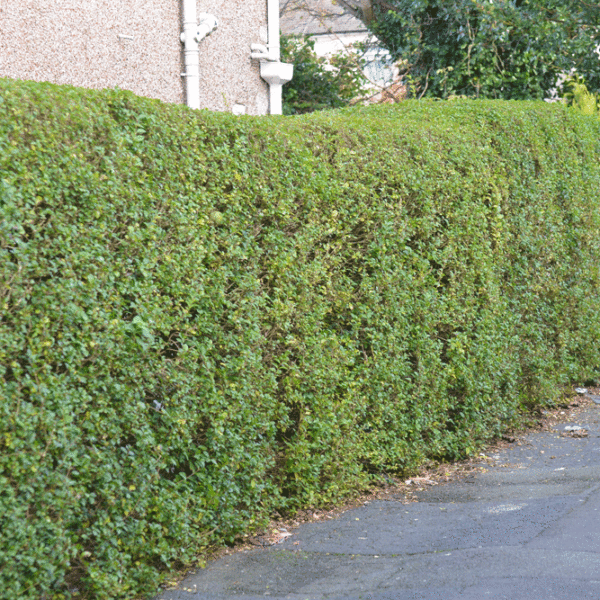
Privet Hedge Plants for Sale
Privet makes a dense garden boundary with small, oval green leaves and plenty of fine branching that responds well to clipping. Bare root privet hedge plants are a practical choice for longer planting runs, especially where you want a tidy screen without the slower growth of yew or box. Our Ligustrum ovalifolium (oval-leaf privet) is available as individual bare root plants in two heights: 40 to 60cm and 60 to 90cm. Bare root privet is lifted during the dormant season, roughly November to March, and should be planted promptly while the roots are still dormant. Privet hedging tolerates most soils, copes with partial shade and responds well to regular trimming. In a mild UK winter, privet often retains much of its foliage. Colder or exposed gardens may see noticeable leaf loss, followed by fresh green shoots in spring. Plant it alone for an evenly clipped boundary or combine it with other hedging species for a looser, mixed screen. Good spacing, an early formative prune and reliable watering during the first growing season will help develop the dense growth you want.
Privet hedging plants for sale
We offer bare root privet in two sizes. Both are sold as single plants, with no minimum order quantity beyond the single unit. Choose the size that matches your budget and how quickly you want a solid screen. The smaller 40 to 60cm plants are economical for long runs and fill out rapidly with good aftercare. The taller 60 to 90cm plants provide more initial height, although both sizes will need time to branch and fill out before forming an effective eye-level screen. All our privet is Ligustrum ovalifolium, the classic garden privet with oval, mid-green leaves and creamy white flower panicles in summer if left untrimmed.
| Size supplied | Root type | Pack size | Ideal for |
|---|---|---|---|
| 40-60cm | Bare root | 1 plant | Budget-friendly long runs; quick to establish |
| 60-90cm | Bare root | 1 plant | Faster impact; closer to screening height sooner |
Why privet: speed, density, semi evergreen in hard winters
Privet grows faster than most formal hedging plants, putting on 30 to 60cm of new growth each year once established. That speed, combined with its willingness to branch after hard pruning, creates a dense, twiggy structure that holds its shape well. In a normal British winter the foliage stays green and attached, though a prolonged cold snap (below about -10°C) will cause some leaf drop. New leaves appear quickly in March or April, so the hedge rarely looks bare for long. Privet suits urban and suburban gardens where pollution, regular clipping or variable soil conditions make other hedges harder to manage. It tolerates soil ranging from slightly acidic to chalky and grows in full sun or partial shade. On exposed sites, expect more winter leaf loss than in sheltered gardens.
How many privet plants per metre
For a single row hedge, plant 4 to 5 privet plants per linear metre. A staggered double row, which gives a thicker hedge faster, uses 5 to 7 plants per metre. The exact number depends on the size you buy and how quickly you want a solid screen. Smaller 40 to 60cm plants can be set at the closer end of the range; larger 60 to 90cm plants can go slightly wider without leaving gaps. Below is a quick reference for common hedge lengths.
| Hedge length | Single row (4 plants/m) | Single row (5 plants/m) | Double row (6 plants/m) |
|---|---|---|---|
| 5 metres | 20 plants | 25 plants | 30 plants |
| 10 metres | 40 plants | 50 plants | 60 plants |
| 20 metres | 80 plants | 100 plants | 120 plants |
Planting bare root privet
Bare root privet is planted during the dormant season, roughly November to March, as long as the ground is not frozen or waterlogged. On arrival, unwrap the plants and soak the roots in a bucket of water for an hour or two if they look dry. Dig a trench wide and deep enough to spread the roots comfortably, around 30cm wide and 20cm deep for most plants. Mix the excavated soil with well-rotted garden compost or soil improver, but avoid fresh manure or high-nitrogen fertiliser at planting time, which can burn new roots. Set each plant at the same depth it was growing in the field (look for the soil mark on the stem), firm the soil gently with your heel and water thoroughly. A mulch of bark or leaf mould helps retain moisture and suppress weeds. Keep the young hedge watered during dry spells in its first growing season.
When to trim a privet hedge
Privet responds well to regular clipping and can be kept as low as 1m or allowed to grow into a tall screen of 3m or more. Trim two to three times during the growing season, from May to September. The first cut in late spring (May or early June) tidies the shape after the initial flush of growth. A second trim in mid to late summer (July or August) keeps the hedge neat through autumn. If growth is strong, a light third trim in September is fine, but avoid cutting after the end of September: soft regrowth can be damaged by early frosts. Always use sharp shears or a hedge trimmer and cut back to just above a leaf joint. Taper the sides slightly so the base is wider than the top; this lets light reach the lower branches and stops the hedge thinning at ground level. For more detail, see our full guide to trimming a privet hedge.
Privet vs box vs Lonicera nitida
Privet, box (Buxus sempervirens) and Lonicera nitida can all be clipped into formal hedges. Privet is best suited to a taller boundary, while box grows more slowly and is often kept as low edging. Lonicera nitida produces fine foliage and grows quickly but needs frequent clipping. Garden Hedges sells bare root privet and box; Lonicera nitida is included here for comparison rather than as an available product. Box is fully evergreen, slow-growing (10 to 15cm a year) and ideal for low parterres and edging under 1m. It needs well-drained soil and can suffer from box blight and box tree caterpillar. Lonicera nitida, sometimes called poor man's box, is fast and dense like privet, with tiny leaves, but it needs very frequent trimming (four to five times a year) to look tidy and can become woody at the base if neglected. Privet sits in the middle: faster than box, less demanding than Lonicera, and semi-evergreen rather than fully evergreen. It grows happily on most soils and reaches 2.5 to 4m if left unclipped, making it the better choice for taller boundary screens.
| Feature | Privet (Ligustrum ovalifolium) | Box (Buxus sempervirens) | Lonicera nitida |
|---|---|---|---|
| Growth rate | 30-60cm per year | 10-15cm per year | 30-50cm per year |
| Evergreen? | Semi-evergreen | Fully evergreen | Fully evergreen |
| Typical hedge height | 1-4m | 0.3-1.5m | 0.5-2m |
| Trimming frequency | 2-3 times a year | 1-2 times a year | 4-5 times a year |
| Soil tolerance | Most soils, including chalk | Well-drained; dislikes wet | Most soils, not waterlogged |
| Common problems | Honey fungus, privet wilt | Box blight, box caterpillar | Aphids, can become leggy |
Feeding a privet hedge
Privet is not a heavy feeder, but an annual mulch and a spring feed keep it growing strongly. In March or April, spread a 5cm layer of well-rotted compost or manure around the base, keeping it clear of the stems. Follow this with a handful of general-purpose granular fertiliser, such as Growmore or fish, blood and bone, scattered along the hedge line and watered in. Avoid high-nitrogen lawn feeds, which encourage soft, sappy growth that is prone to frost and aphids. On very poor sandy soils, a second light feed in early summer can help, but stop feeding by August so the wood hardens before winter.
Common problems with privet hedges
Privet can suffer from several problems, but yellow leaves or dieback do not always mean disease. First check soil moisture and drainage, especially with newly planted bare root hedging. Honey fungus (Armillaria) can cause dieback, white fungal growth beneath the bark and honey-coloured toadstools in autumn. There is no chemical cure, and confirmed infections may require removing affected plants and roots. Wilting and yellowing can also follow root damage, waterlogging or fungal disease, so identify the cause before treating the hedge. Aphids can cluster on new shoots in spring, causing leaf curl; they are usually controlled by birds and ladybirds, or you can spray with a soap-based insecticide. Leaf spot fungi cause brown spots and premature leaf fall in wet summers; rake up fallen leaves and prune to improve airflow. Frost damage can cause leaf drop and dieback on young plants; protect with fleece in very cold spells or plant in a sheltered position.
Expert tip: getting a thick hedge from the start
An early formative prune helps young privet branch from low down rather than growing into a line of tall, thin stems. For healthy bare root plants, shorten the leading shoots by about one-third to one-half in late winter or early spring, adjusting the amount to the condition and shape of each plant. This encourages lower branching and helps build the framework of a thicker hedge. Without this initial prune, privet can grow tall and leggy with bare lower stems that never fill in properly. Do this in late winter or early spring, just as the buds begin to swell. Water well afterwards and apply a mulch. The plants will look stubby for a few weeks, then push out multiple shoots and thicken rapidly.
Questions before you order
How fast does a privet hedge grow?
Once established, privet grows 30 to 60cm per year. In the first year after planting bare root plants, growth is slower while the roots settle in, but from the second season onwards you can expect vigorous upright shoots. Regular feeding and watering during dry spells help maintain this growth rate.
Is privet hedge evergreen?
Privet is semi-evergreen. In a typical UK winter it keeps most of its leaves, giving good screening. During very cold winters (below -10°C) or on exposed sites, it may lose some or all of its foliage, but new leaves appear quickly in spring. It is not as reliably evergreen as yew or holly.
When is the best time to plant a privet hedge?
Bare root privet is planted during the dormant season, roughly November to March. Avoid planting when the ground is frozen or waterlogged. Container-grown privet can be planted at any time of year, but we supply bare root plants only, for planting in that winter window.
How far apart should I plant privet hedging?
For a single row, space plants 20 to 25cm apart (4 to 5 per metre). For a thicker double row, set plants 25 to 30cm apart in each row, with 30cm between rows, giving 5 to 7 plants per metre. Closer spacing gives a denser hedge sooner but needs more plants.
Can privet grow in shade?
Yes, privet tolerates partial shade well. In deep shade, growth will be thinner and slower, and the hedge may become leggy. For the densest growth, plant in full sun or light shade. It also copes with north-facing positions where many other hedging plants struggle.
Is privet poisonous to dogs or people?
Privet leaves and berries contain compounds that can cause stomach upset if eaten in quantity. The small black berries are mildly toxic to humans and pets, though cases of serious poisoning are rare. If you have dogs that chew plants, consider a non-toxic alternative or fence off the hedge.
How tall will a privet hedge grow?
Left unclipped, Ligustrum ovalifolium can reach 4m or more. As a trimmed hedge, it is easily maintained at any height from 1m to 3m. Regular trimming keeps it dense and manageable. For a very low hedge under 1m, box is another option sold by Garden Hedges, available as 20 to 40cm bare root plants. Lonicera nitida is also commonly used for low edging, although it is not part of the current catalogue.
Why is my privet hedge losing leaves in summer?
Summer leaf drop can be caused by drought stress, privet wilt or leaf spot diseases. Check the soil moisture first: water deeply during dry spells. If leaves have brown spots or yellow patches, a fungal issue may be present. Improve airflow by pruning and clear fallen leaves to reduce reinfection.