Broad leaves or a finer clipped finish?
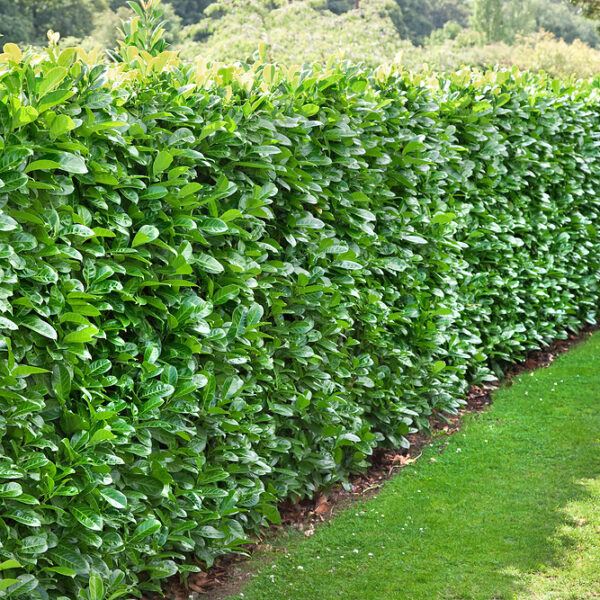
Cherry laurel and Portuguese laurel both make evergreen garden hedges, but they have a different character. Cherry laurel has large, glossy leaves that give a broad, leafy boundary. Portuguese laurel has smaller, more pointed leaves and reddish young stems, giving it a finer texture when clipped.
Look closely at the foliage when comparing the two. Cherry laurel makes a substantial backdrop to borders, while Portuguese laurel suits a more finely clipped outline. Both need enough room to develop and regular trimming to hold the height and width you choose.
Cherry and Portuguese laurel compared
Both can become large shrubs or trees if left untrimmed. Plan around the maintained hedge you want in a few years, including the space you will need to trim it.
| Feature | Cherry laurel | Portuguese laurel |
|---|---|---|
| Botanical name | Prunus laurocerasus | Prunus lusitanica |
| Foliage | Broad, glossy evergreen leaves | Smaller evergreen leaves, often with red leaf stalks and young stems |
| Typical garden use | Leafy boundary hedges and screening | Clipped hedges and a finer-textured evergreen screen |
| Planning consideration | Allow for the width of its broad-leaved growth | Allow room for clipping and future branch growth |
| Buying detail | Compare height, pot size and quantity | Compare height, pot size and quantity |
Soil, shade and drainage
Laurels need moisture at the roots, but standing water is a problem. Check the boundary in wet weather as well as summer: a damp border that drains after rain is quite different from a trench that stays waterlogged.
Both species grow in sun or partial shade. Under mature trees, the main difficulty may be competition for water rather than shade itself. Check how much rain reaches the ground and whether you can water during establishment. If your soil is chalky, the position is very exposed or the ground stays wet, tell us when asking which laurel to choose.
Allow for growth and establishment
Cherry laurel is often chosen for its vigorous growth and broad foliage. Portuguese laurel appeals where a smaller leaf and finer clipped surface are preferred. How quickly either fills out depends on the soil, moisture, starting size and space between plants.
Smaller plants can keep the cost of a long boundary manageable when there is time for growth. Taller stock gives more height at planting, but still needs watering while its roots establish. Whichever size you choose, leave enough of the budget for ground preparation and aftercare.
Plan how you will keep the hedge in shape
Regular pruning is easier than recovering an overgrown boundary. Decide the maintained height and width before the hedge reaches them, and leave enough access for the tools you intend to use. A slight taper, with the base broader than the top, helps light reach the lower foliage.
On cherry laurel, shears can slice through the large leaves and leave conspicuous cut edges. Secateurs allow you to shorten shoots at a junction while keeping surrounding leaves intact. This is slower on a long boundary, but it gives a tidier finish in prominent parts of the garden. Check for active birds’ nests before any cutting.
Choose a supplied size and quantity
Select the root type and size before comparing prices. A 40-60cm plant in a P9 pot and a 60-90cm plant in a 2 litre pot offer different starting points. Check the minimum order, confirm the spacing and calculate the total number needed for the boundary.
The laurel category brings the available options together. Compare the botanical name as well as the supplied height, particularly if you are extending an existing hedge and want the new plants to match it.
Compare laurel hedging plants Understand plant and pot sizes
Common questions
Is Portuguese laurel the same as cherry laurel?
No. They are different species in the Prunus genus, with different leaf shapes and growth habits. Compare the botanical name as well as the common name.
Do laurel hedges stay green in winter?
Both cherry laurel and Portuguese laurel are evergreen. Individual old leaves are still shed and replaced, and poor growing conditions can affect foliage.
Are laurel leaves edible?
No. Ornamental cherry and Portuguese laurels are not culinary bay. Do not use their foliage or fruit in food and keep clippings away from animals.