Euonymus fortunei 'Emerald 'n' Gold'
£8.99 per plant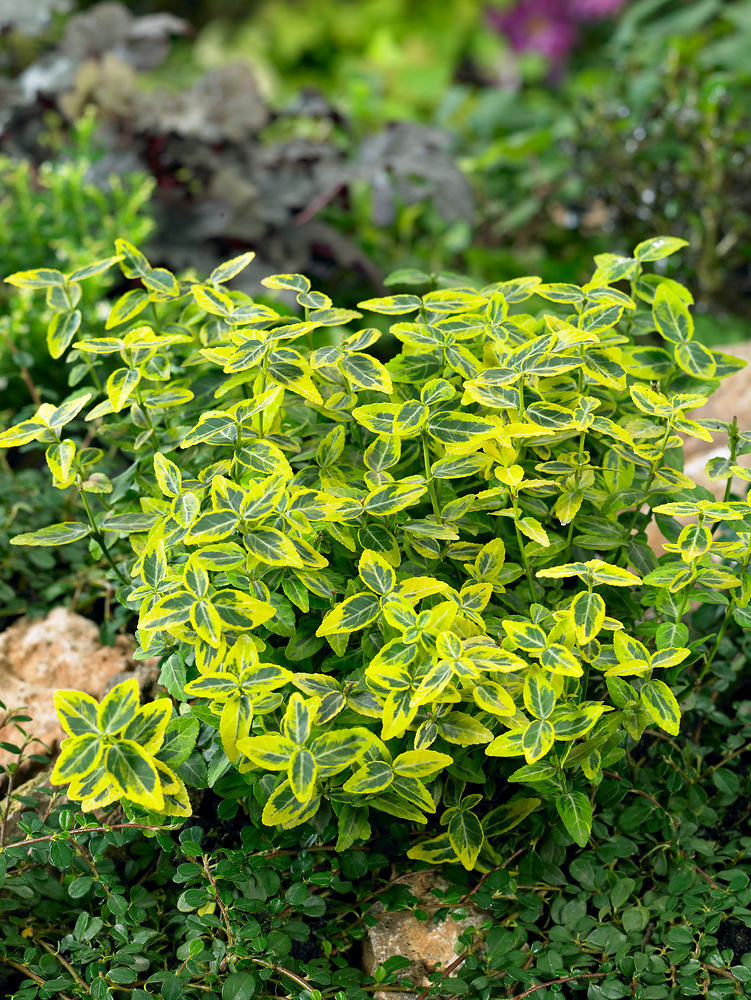
- UK Nursery Grown
- Planting Advice
Euonymus Emerald 'n' Gold Shrubs for Sale UK
Euonymus fortunei 'Emerald 'n' Gold'
£8.99 per plant
Euonymus Emerald 'n' Gold has small, dark green leaves edged in golden yellow, with the margins often turning pink in cold weather. This low, spreading evergreen works well at the front of borders, along paths or in patio pots. Choose a young plant in a 9cm pot for growing on, or a more established shrub in a 2 litre pot. Both options are supplied as single plants.
- Evergreen leaves with golden-yellow margins
- Compact, spreading habit to 60cm
- Winter foliage develops pink tones
Step 1: Choose Your Root Type
Pot-grown plants, supplied in the pot size shown for each option. Plant at any time of year when the ground is workable. Ask about this plant
Understanding root types
- Bare root
- Lifted with little or no soil around the roots. Keep the roots moist and plant during the dormant season.
- Rootball
- Supplied with soil around the roots. Handle the rootball carefully and follow its planting instructions.
- Potted
- Grown in a nursery container. The pot size and supplied height are shown with each plant option.
Step 2: Choose Your Plant
Need help with your planting?Ask about sizes, root types and quantities
Position
Full sun to partial shade
Soil
Well-drained soil, any pH
Supplied size
9cm pot
Ordering
Order from 1 plant
Description
Euonymus Emerald 'n' Gold Shrubs for Sale UK
What is Euonymus Emerald 'n' Gold?
Euonymus fortunei 'Emerald 'n' Gold' is a low, bushy evergreen shrub grown for its brightly variegated foliage. The small, oval leaves have dark green centres and broad golden-yellow margins, which stand out against darker foliage in borders and containers. As temperatures fall, the yellow edges often turn pink, bringing a change of colour through winter.
Small, greenish flowers may appear in summer, although they are easily missed among the leaves. The evergreen foliage provides colour throughout the year, while the branches gradually spread into a dense, low mound. Against a suitable wall, older stems may develop aerial roots and climb, although the plant is usually grown as ground cover or a compact shrub.
Why choose this euonymus?
Emerald 'n' Gold is a hardy, adaptable evergreen that grows in full sun or partial shade. Its golden leaf margins develop their strongest colour where the plant receives some direct sunlight. It also grows in sheltered, lightly shaded borders, although the variegation can become less distinct without enough light. Choose well-drained soil and avoid cold, waterlogged ground, particularly in exposed gardens.
Its naturally low growth makes it easy to manage along paths and at the front of borders, although older plants can spread beyond their original space. Trim once or twice a year to control the shape, and cut out any shoots with entirely green leaves. These reverted stems tend to grow more strongly than the variegated branches and can eventually dominate the shrub.
Eventual height, spread and growth rate
In the garden, Emerald 'n' Gold commonly grows to around 50 to 60cm tall, with a similar spread after several years. Older plants may extend to 1m across without pruning. Growth is generally slow to moderate, often around 10 to 20cm a year, depending on light, soil moisture and growing conditions.
When grown against a wall, the stems may climb to 1.5m or more, but the plant will not reach the height of a true climber. Regular trimming keeps it dense and prevents it becoming leggy at the base.
How to use Emerald 'n' Gold
Plant Emerald 'n' Gold along a path for a low, informal hedge, or use its golden-edged foliage to mark the front of a mixed border. It also fills spaces between taller shrubs, where the spreading branches gradually cover bare soil. On banks and slopes, groups of plants can knit together into low ground cover, helping to reduce weed growth as they establish.
In a patio container, the spreading branches can grow over the rim, softening its outline. The variegated leaves remain through winter, keeping pots colourful after summer bedding has faded. Emerald 'n' Gold can also grow near a north-facing wall if there is enough indirect light, although its yellow margins may be less vivid than in a sunnier position.
Choosing a size
Emerald 'n' Gold is available as a single plant in either a 9cm or 2 litre pot. Choose the 9cm pot for planting several shrubs along a border or growing them on before putting them in their final positions. The 2 litre option provides a more established plant for a patio container, a small gap in a border or a low hedge where you want a larger shrub from the start.
| Option | Supplied size | Pot or root type | Best for | Plants per metre (hedge) |
|---|---|---|---|---|
| 9cm pot | 1 plant | Young plant; height varies | 9cm pot | Economical planting, growing on | 4 to 5 |
| 2 litre pot | 1 plant | Established shrub; height varies | 2 litre pot | Containers, borders, individual shrubs | 3 to 4 |
Does Euonymus Emerald 'n' Gold climb a wall or fence?
Emerald 'n' Gold can climb when its stems develop aerial roots against a suitable surface, although it grows much more slowly than ivy. Rough brick or stone offers better support than a smooth wall, where stems may need tying in. A timber fence may also need additional support for the branches. Check soil moisture regularly during establishment, especially beneath walls where the ground can remain dry even after rain.
Planting and care
Planting and aftercare
When and how to plant
Container-grown euonymus can be planted at any time of year when the ground is not frozen or waterlogged. Spring and early autumn are ideal, giving roots time to settle before summer heat or winter cold. Water the pot thoroughly before planting.
Dig a hole twice the width of the rootball and the same depth. Tease out any circling roots, set the plant at the same level it was in the pot, backfill and firm gently. Water well and mulch with bark or compost to retain moisture and suppress weeds.
Spacing for a low hedge
For a dense, continuous low hedge, space plants 20 to 25cm apart in a single row. This encourages the branches to meet as the shrubs develop. For a wider hedge, use two staggered rows around 20cm apart, with plants approximately 33cm apart along each row. The double-row quantities below are based on six plants per metre of hedge length.
| Hedge length | Plants needed (single row, 4 per metre) | Plants needed (double row, 6 per metre) |
|---|---|---|
| 5 metres | 20 | 30 |
| 10 metres | 40 | 60 |
| 20 metres | 80 | 120 |
Watering and feeding
Keep the soil moist while the plant establishes, especially during the first growing season. Check container-grown plants regularly; they dry out faster than those in the ground. Water at the base rather than over the leaves to reduce the risk of mildew.
Apply a general-purpose granular fertiliser, such as Growmore or blood, fish and bone, in spring, following the pack instructions. Container plants may benefit from another light feed in early summer if growth is weak or nutrients are running low. Avoid high-nitrogen fertilisers late in the season, as they can encourage soft new shoots that are more vulnerable to frost.
Trimming and maintenance calendar
Trim in spring to shorten long or uneven branches, making each cut just above a healthy bud or leaf joint. This encourages branching and helps the shrub stay compact. If stems grow beyond the intended outline during summer, give them another light trim before autumn.
At any time of year, remove shoots that have reverted to plain green. Cut them right back to the point where they join a variegated stem. If left, these vigorous green shoots will gradually take over the plant.
| Month | Task |
|---|---|
| March to April | Main trim to shape; remove dead or damaged stems |
| April to May | Apply spring feed; mulch if not done in autumn |
| June to July | Light summer trim if needed; check watering |
| August to September | Final light trim to tidy; remove any green reverted shoots |
| October to March | No trimming; clear fallen leaves from around the base |
Choose evergreen shrubs for the position Understand pot sizes Care after planting
Read our planting guideFurther growing advice: RHS plant and growing guidance
Sizes and prices
Euonymus Emerald 'n' Gold sizes, prices and minimum orders
| Option | Supplied height | Pot or root | Plants | Price | Minimum order | Availability |
|---|---|---|---|---|---|---|
| 9cm pot | 1 plant | – | 9cm pot | 1 | £8.99 per plant | None | Available |
| 2 litre pot | 1 plant | – | 2 litre pot | 1 | £12.99 per plant | None | Available |
The price is for the selected plant or pack. Pack size tells you how many plants are included, and the minimum order is the smallest quantity we can send.
Plant sizes and quantities explainedDelivery
Delivery for your plant order
Delivery options and charges are shown in your basket and confirmed before you place your order.
Plants are living products. Unpack promptly after delivery, check moisture around the roots and keep them in a sheltered spot until you can plant.
Delivery informationPlant questions
Before you order
Does Euonymus like sun or shade?
Euonymus Emerald 'n' Gold grows well in full sun to partial shade. The golden leaf margins show their strongest colour with some direct sunlight, although the shrub also grows in light shade. Deep shade can produce weaker, more open growth and less distinct variegation, so choose a brighter position where possible. Avoid positions where the soil dries out completely in hot sun, as this can scorch the leaf edges.
How big does Euonymus Emerald 'n' Gold grow?
As a free-standing shrub it typically reaches 50 to 60cm in height and spread, though it can slowly spread wider if left unpruned. Against a wall or fence the stems may climb to 1.5m or more. Regular trimming keeps the plant compact and bushy. The growth rate is slow to moderate, averaging 10 to 20cm per year.
Can Euonymus be grown as a low hedge?
Yes. Emerald 'n' Gold forms a low, informal hedge with green and gold foliage throughout the year. Space plants 20 to 25cm apart in a single row so their branches can gradually meet. It suits path edges and border boundaries rather than tall privacy screening. Trim once or twice a year to control its width, and remove any shoots that produce entirely green leaves.
Does it climb a wall or fence?
Emerald 'n' Gold can climb slowly if its stems develop aerial roots against a suitable surface. Rough brick or stone offers a better hold than smooth walls, where the branches may need tying in. Timber fences may also require supports. Keep an eye on soil moisture during establishment, particularly at the foot of a wall where rain may not reach the roots.
Why do some leaves turn plain green?
Variegated plants sometimes produce shoots that revert to the parent plant's plain green form. These shoots are more vigorous and can outgrow the variegated growth. Cut them out completely as soon as you see them, tracing the stem back to its origin on a variegated branch. Check for new green shoots when trimming in spring and again during summer, removing them before they spread.
Is Euonymus Emerald 'n' Gold toxic?
Euonymus fortunei is harmful if eaten, and its sap may irritate sensitive skin. Berries are uncommon on Emerald 'n' Gold but should not be consumed. Keep children and pets from eating any part of the shrub. Wear gloves when pruning, especially if your skin is sensitive, and wash your hands after handling the plant.
Ask a plant question