What is the right hedge spacing?
Measure hedge spacing from the centre of one plant to the centre of the next. Small bare root plants such as privet and hawthorn may be placed around 25 to 33cm apart, while vigorous conifers such as Leylandii are commonly spaced 60 to 100cm apart. The starting size and finished hedge width also affect the distance you choose. Getting the spacing right determines how quickly your hedge fills out, how dense it becomes, and how much competition there is for water and nutrients.
The number of plants per metre is simply 1 divided by the spacing in metres. If you plant at 50cm (0.5m) centres, you need 2 plants per metre. For a double staggered row, you roughly double the quantity and offset the plants to create a thicker barrier. The table below gives the recommended planting distances for the hedging we supply, along with the plants needed for common hedge lengths.
| Hedge species | Single row spacing | Plants per metre (single row) | Plants for 5m hedge | Plants for 10m hedge |
|---|---|---|---|---|
| Cherry laurel | 60cm (2 per metre) | 2 | 10 | 20 |
| Portuguese laurel | 60cm (2 per metre) | 2 | 10 | 20 |
| Green beech | 30 to 45cm (3 per metre) | 3 | 15 | 30 |
| Common hawthorn | 30cm (3 to 4 per metre) | 3 to 4 | 15 to 20 | 30 to 40 |
| Privet | 30cm (3 to 4 per metre) | 3 to 4 | 15 to 20 | 30 to 40 |
| English yew | 30 to 45cm (3 per metre) | 3 | 15 | 30 |
| Box (Buxus) | 15 to 20cm (5 to 7 per metre) | 5 to 7 | 25 to 35 | 50 to 70 |
| English holly | 45cm (2 to 3 per metre) | 2 to 3 | 10 to 15 | 20 to 30 |
| Green Leylandii | 60 to 100cm (1 to 2 per metre) | 1 to 2 | 5 to 10 | 10 to 20 |
| Castlewellan Gold | 60 to 100cm (1 to 2 per metre) | 1 to 2 | 5 to 10 | 10 to 20 |
Why hedge spacing matters
Plants set too close together compete for light, moisture and soil nutrients. The result is often a thin, leggy hedge with more dead wood and a shorter lifespan. Overcrowding also encourages fungal problems because air cannot circulate between the stems.
Wide gaps take longer to close, particularly with slower-growing plants such as yew or box. Suitable spacing gives the roots room to develop while allowing neighbouring branches to meet. Fast-growing species may form a continuous screen within two to three growing seasons under favourable conditions, but smaller plants and difficult sites can take longer.
- Too close: stunted growth, poor airflow, higher risk of disease
- Too far apart: slow to form a continuous screen, gaps may persist
- Correct spacing: even growth, dense cover, healthier plants
Laurel hedge spacing: cherry and Portuguese
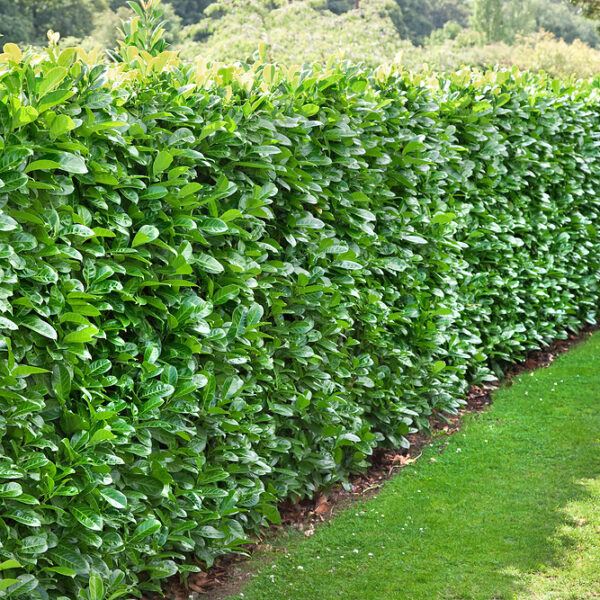
Cherry laurel (Prunus laurocerasus) is a vigorous evergreen that makes a broad, dense hedge. For a single row, plant at 60cm intervals, which works out at 2 plants per metre. If you want a really thick screen quickly, use a double staggered row with the same spacing between plants and 40 to 50cm between the rows.
Portuguese laurel (Prunus lusitanica) has a slightly neater habit and smaller leaves, but the spacing recommendation is the same: 60cm for a single row, or a double row for extra density. Cherry laurel typically grows 30 to 60cm annually once established, while Portuguese laurel is usually slower at around 20 to 40cm. At 60cm centres, neighbouring plants may meet within a few growing seasons, depending on their starting size and conditions. Allow approximately 2 plants per metre for a single row or 4 for a staggered double row, rounding quantities to suit the measured length.
- Cherry laurel: 2 per metre (single row), 4 per metre (double row)
- Portuguese laurel: 2 per metre (single row), 4 per metre (double row)
- Both suit 60cm spacing for a balanced, fast-filling hedge
How far apart should a beech hedge be planted?
Green beech (Fagus sylvatica) holds its coppery dead leaves through winter, giving you year-round screening even though it is deciduous. Plant beech at 3 plants per metre for a single row, which means a spacing of roughly 33cm. Some gardeners go to 4 per metre (25cm spacing) for a very dense, low hedge, but 3 per metre is the standard recommendation for a hedge that will reach 1.5 to 2.5m tall.
Our green beech hedging is listed at 90 to 120cm, with the root type not specified in the catalogue. Check the supplied root type before planning the planting date. At 3 plants per metre, regular shaping encourages branching near the base, and a single row is usually sufficient for an ordinary garden boundary.
How many leylandii per metre?
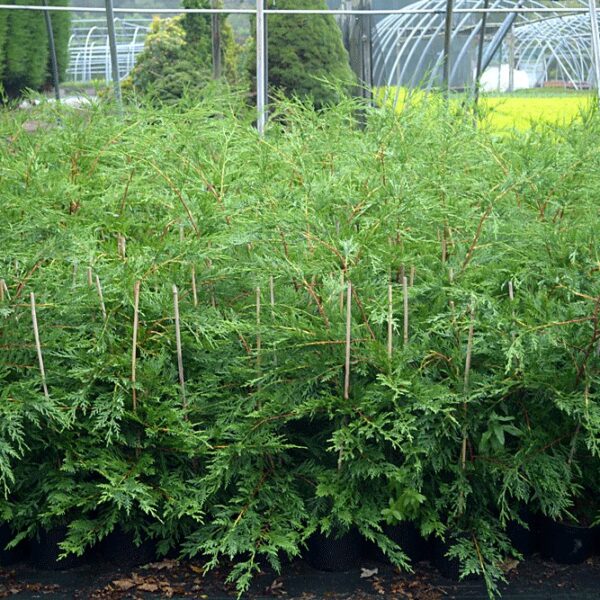
Leylandii (x Cuprocyparis leylandii) is the fastest-growing conifer hedging, capable of 60 to 90cm of growth per year. Because it is so vigorous, spacing is wider than for most other hedge plants. For green Leylandii and Castlewellan Gold, plant at 60 to 100cm apart in a single row. That gives you 1 to 2 plants per metre.
A 60cm spacing (2 per metre) will form a solid screen more quickly but requires earlier and more frequent trimming to keep the hedge manageable. A 100cm spacing (1 per metre) is adequate if you are willing to wait an extra year for the plants to meet. Never plant leylandii closer than 60cm, as the competition will weaken the plants and increase the risk of conifer aphid and needle browning. For a double row, keep the same in-row spacing and set the rows 50 to 70cm apart.
- Green Leylandii: 1 to 2 per metre (60 to 100cm spacing)
- Castlewellan Gold: 1 to 2 per metre (60 to 100cm spacing)
- Wider spacing suits a lower-maintenance hedge trimmed once a year
Spacing for other popular hedge plants
Common hawthorn and privet are commonly planted at 4 per metre, or 25cm centres, to create a closely branched garden hedge. Larger 60 to 90cm bare root plants can also be spaced at 3 per metre if you can allow more time for the gaps to close. For a livestock boundary, planting density alone does not make a young hedge stock-proof, so temporary fencing may still be needed.
English yew is slower growing but extremely long-lived. Plant at 3 per metre (33cm spacing) for a formal hedge. Box (Buxus) used for low parterres and edging is planted much closer: 5 to 7 per metre (15 to 20cm spacing) to create a tight, neat finish. English holly is best at 2 to 3 per metre (45cm spacing), as it naturally forms a bushy shape without needing to be crowded.
What happens if you plant hedging too close together?
Overcrowding is one of the most common mistakes when planting a new hedge. When plants are too close, the roots compete fiercely for water and nutrients, and the shoots stretch upwards searching for light. This produces tall, spindly plants with bare lower stems, which is the opposite of the dense, leafy screen most people want.
Crowded hedges also trap moisture and reduce airflow, creating ideal conditions for powdery mildew, leaf spot and box blight. In extreme cases, weaker plants are shaded out and die, leaving gaps that are difficult to fill later. Sticking to the recommended spacing for your species is a simple way to avoid these problems.
Single row vs double row spacing
A single row is the standard planting pattern for most garden hedges. It uses fewer plants, costs less, and is easier to weed and trim. A double staggered row uses roughly twice as many plants, with the second row offset so each plant sits in the gap of the first row. This creates a wider, denser hedge more quickly.
Double rows are most useful for laurel, leylandii and hawthorn where you want a thick screen from ground level upwards. The spacing between plants within each row stays the same as for a single row, and the distance between the two rows is usually 40 to 60cm. For a double row of cherry laurel at 60cm spacing, you need 4 plants per linear metre of hedge.
| Planting pattern | Plants per metre (laurel example) | Best for |
|---|---|---|
| Single row | 2 | Most garden hedges, lower cost |
| Double staggered row | 4 | Thick screens, exposed sites, fast privacy |
How to calculate how many hedge plants per metre
Calculating the number of plants for your hedge is straightforward. First, measure the total length of the hedge run in metres, excluding any gates or gaps. Then decide on the spacing for your chosen species. Divide the length by the spacing in metres to get the plant count for a single row.
For example, a 12 metre hedge of cherry laurel at 60cm spacing: 12 ÷ 0.6 = 20 plants. For a double row, multiply by 2, giving 40 plants. Always round up to the nearest whole plant, and add a couple of spares in case any fail to establish. The table below shows the calculation for three common hedge lengths.
| Hedge length | Spacing | Single row plants | Double row plants |
|---|---|---|---|
| 5 metres | 60cm | 9 (round up from 8.3) | 18 |
| 10 metres | 60cm | 17 (round up from 16.7) | 34 |
| 20 metres | 60cm | 34 (round up from 33.3) | 68 |
Hedge spacing and eventual height
The spacing you choose also influences the maximum height your hedge can sustain. Leylandii can grow beyond 5m if left to develop, but a tall hedge needs enough width for healthy lower branches and regular maintenance. Planting too closely increases competition for water and nutrients, particularly as the trees mature. Choose spacing for the intended height and available width rather than relying on a fixed maximum height for each planting distance.
For most garden hedges kept between 1.5 and 2.5m, the standard spacings in our table work well. If you plan to let a hedge grow taller than 3m, consider widening the spacing slightly and using a double row to maintain density without compromising root health. In England and Wales, complaints about qualifying high hedges are covered by Part 8 of the Anti-social Behaviour Act 2003. A hedge over 2m is not automatically unlawful, but a council may investigate if it adversely affects a neighbour's reasonable enjoyment of their property. Different rules apply in Scotland and Northern Ireland, and property covenants may impose additional restrictions.
Hedge planting and spacing: a month-by-month guide
Plant bare root hedging during the dormant season, normally November to March, while the soil is workable. Pot-grown hedges can be planted throughout the year, although spring and autumn usually reduce watering demands. Keep the chosen spacing consistent along the planting line, and use the seasonal notes below to plan ground preparation and aftercare.
| Month | Planting activity | Spacing notes |
|---|---|---|
| November to February | Plant bare root hedging (beech, hawthorn, privet, yew, bare root leylandii). Ideal time. | Stick to recommended spacing; plants are dormant and establish quickly. |
| March | Plant bare root (last chance) and pot-grown hedging. | Soil warming up; water pot-grown plants well. |
| April to May | Plant pot-grown hedging only. | Check spacing carefully; new growth can make plants look larger than they are. |
| June to August | Plant pot-grown hedging with regular watering. | Wider spacing may be wise to reduce competition for water. |
| September to October | Plant pot-grown hedging; prepare ground for bare root orders. | Good time to assess gaps and order replacements. |
Common hedge spacing mistakes
Small plants can make a freshly planted hedge look sparse. A 40 to 60cm cherry laurel in a 9cm pot may leave a noticeable gap at 60cm centres, especially in the first year. It can take several growing seasons for the branches to meet, depending on soil and watering. Keep to the planned spacing rather than crowding plants together to make the new hedge look fuller immediately.
Another mistake is forgetting to adjust spacing for corners and curves. On a tight curve, you may need to reduce the spacing slightly so the hedge line stays smooth. Mark out the positions with canes before you dig, and step back to check the line from both ends.
- Planting too close because plants look small
- Not adjusting spacing on curves and corners
- Using the same spacing for all species
- Forgetting to allow for access when measuring the run
Common questions
How many cherry laurel per metre?
For a single row, plant 2 cherry laurel per metre (60cm spacing). A double staggered row uses 4 plants per metre. This spacing gives each plant enough room to develop a strong root system while forming a dense evergreen screen within two to three growing seasons.
How far apart should a beech hedge be planted?
Plant green beech at 3 plants per metre, which is roughly 33cm apart. This spacing creates a dense, twiggy hedge that holds its brown winter leaves well. For a lower hedge under 1m, you can increase to 4 per metre (25cm spacing).
How many leylandii per metre?
Plant green Leylandii and Castlewellan Gold at 1 to 2 plants per metre, which is a spacing of 60 to 100cm. A 60cm spacing (2 per metre) forms a screen faster but needs more frequent trimming. Never plant leylandii closer than 60cm, as overcrowding weakens the plants.
What happens if you plant hedging too close together?
Plants compete for water, nutrients and light, leading to thin, leggy growth with bare lower stems. Overcrowding also reduces airflow, increasing the risk of fungal diseases like powdery mildew and leaf spot. In severe cases, weaker plants die and leave permanent gaps.
How many hedge plants per metre for a double row?
A double staggered row uses roughly twice as many plants as a single row. For cherry laurel at 60cm spacing, that means 4 plants per metre. For leylandii at 100cm spacing, a double row uses 2 plants per metre. Keep the same in-row spacing and offset the second row.
How tall can a hedge be between neighbours?
There is no fixed legal height limit for hedges in the UK, but hedges over 2m can be subject to a high hedge complaint under the Anti-social Behaviour Act 2005 if they block light to a neighbour's windows or garden. Local covenants may also set specific height restrictions.