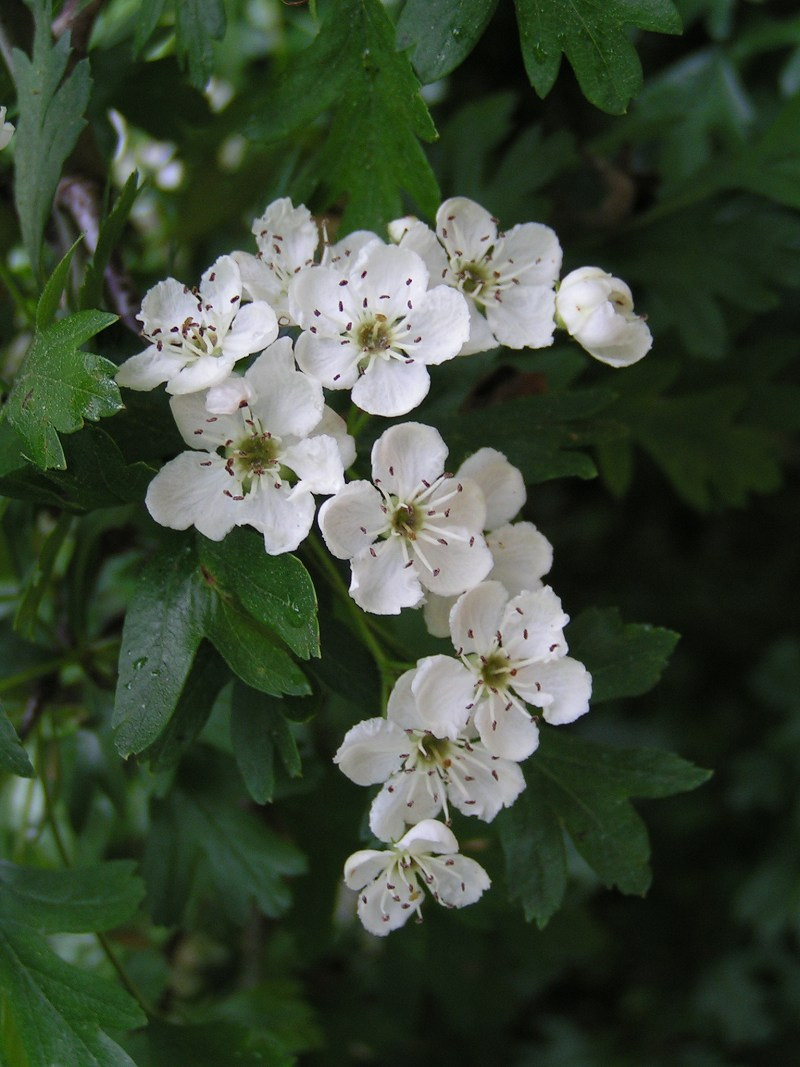
What Makes a Good Hedgerow
Hawthorn makes an excellent starting point for a British hedgerow. Its thorny branches provide nesting cover, spring blossom feeds pollinators and autumn berries attract birds. Adding other suitable species creates a varied boundary, although a planted hedge should not be treated as stock-proof without appropriate fencing. A good hedgerow mix typically combines thorny, fast-growing shrubs like hawthorn with slower, long-lived trees such as holly or beech, plus a few flowering or berry-bearing species for seasonal interest. Aim for a hedge with dense growth near the ground and a mix of flowering, fruiting and evergreen branches. It will still need weed control while young and periodic cutting as it matures, but choosing plants suited to the site makes that work easier.
- Hawthorn (Crataegus monogyna): thorny, quick to establish, excellent for nesting birds
- Blackthorn (Prunus spinosa): early spring flowers for pollinators, sloes for winter food
- Field maple (Acer campestre): attractive autumn colour, tolerant of most soils
- Hazel (Corylus avellana): traditional coppicing species, nuts for wildlife
- Holly (Ilex aquifolium): evergreen, dense shelter, red berries for birds
- Guelder rose (Viburnum opulus): showy flowers and translucent red berries
- Dogwood (Cornus sanguinea): bright winter stems, good on wetter ground
- Spindle (Euonymus europaeus): unusual pink and orange fruits, chalk-tolerant
Hawthorn, Beech, Holly and Privet in a Mixed Hedge
Common hawthorn is a useful main species for a traditional British hedgerow. It grows readily from bare root plants and develops thorny, interlocking branches that provide shelter for wildlife. Hawthorn is tough, thorny and cheap to buy as bare root plants, making it the first choice for long rural boundaries. Adding green beech hedging introduces a different texture: beech holds its copper-brown dead leaves through winter, giving extra screening when hawthorn is bare. English holly hedging brings permanent evergreen structure and glossy foliage, while privet hedging, though semi-evergreen, fills in quickly and tolerates regular clipping. Combining these four species gives the boundary a mix of thorny branches, deciduous foliage and evergreen cover. Their different growth rates mean some plants will need more frequent cutting than others, and no mixture is immune to pests or disease.
| Species | Evergreen/Deciduous | Growth rate per year | Eventual height as a hedge | Plants per metre (single row) |
|---|---|---|---|---|
| Common hawthorn | Deciduous | 40 to 60cm | 3 to 8m | 4 to 5 |
| Green beech | Deciduous (holds dead leaves) | 30 to 60cm | 2 to 5m | 3 to 5 |
| English holly | Evergreen | 20 to 40cm | 2 to 8m | 2 to 3 |
| Privet | Semi-evergreen | 30 to 60cm | 2 to 4m | 4 to 5 |
Planting a Wildlife Hedgerow
For a mixed wildlife hedgerow, three to five compatible species can provide varied food and shelter through the year. A practical combination from our catalogue is common hawthorn, green beech, English holly and privet, with hawthorn making up much of the planting. Bare root hawthorn and privet are useful for planting long boundaries during the dormant season, roughly November to March. Our English holly is supplied in 9cm pots, while the catalogue does not specify a root type for green beech. Prepare a strip of clear ground about 75cm to 1m wide, removing all perennial weeds. Dig in well-rotted organic matter if the soil is poor. Set plants in a staggered double row for the densest cover: two parallel lines 30 to 45cm apart, with plants spaced 30 to 50cm apart within each row. Water thoroughly after planting and mulch with a 5 to 7cm layer of bark or woodchip to suppress weeds and retain moisture.
- Choose 3 to 5 native or naturalised species for resilience and wildlife value
- Plant bare root stock between November and March when plants are dormant
- Use a staggered double row to develop a thicker hedge; add suitable fencing wherever livestock must be contained
- Incorporate an evergreen like holly for year-round cover and nesting sites
- Mulch after planting to keep roots cool and weed-free
Spacing and Double Rows
Spacing depends on the species and how quickly you want a dense hedge. For a mixed hedgerow, a double row is the standard recommendation: it creates a wider, stronger barrier that fills in faster than a single line. Set the two rows 30 to 45cm apart. Within each row, space plants at 30 to 50cm intervals, staggering them so each plant sits opposite a gap in the other row. For a 5m length of double-row hedge you will need roughly 20 to 34 plants, depending on exact spacing. For 10m, allow 40 to 68 plants, and for 20m, around 80 to 136 plants. Bare root hawthorn and privet can be planted towards the closer end of the range for dense growth. Holly develops more slowly, so distribute it throughout the mixture rather than expecting it to close gaps as quickly as hawthorn.
| Hedge length | Single row (plants at 30 to 50cm) | Double row (plants at 30 to 50cm) |
|---|---|---|
| 5 metres | 10 to 17 | 20 to 34 |
| 10 metres | 20 to 34 | 40 to 68 |
| 20 metres | 40 to 68 | 80 to 136 |
Grants for Hedgerow Planting
In many parts of the UK, farmers and landowners can apply for grants to plant new hedgerows or restore old ones. Schemes vary by country and change with each agricultural policy cycle. In England, hedgerow creation and management are often covered under Countryside Stewardship options; in Wales, look at the Sustainable Farming Scheme; in Scotland, check the Agri-Environment Climate Scheme; and in Northern Ireland, the Environmental Farming Scheme. Grant conditions may specify eligible species, planting density, fencing and maintenance. Requirements and application windows vary by scheme, so check the current guidance from the relevant authority before ordering plants. For England, consult Defra and the Rural Payments Agency; for Scotland, Wales and Northern Ireland, use the appropriate government agricultural funding guidance. Even if you are not eligible for a grant, the planting specifications they use are a reliable guide to what makes a successful, long-lasting hedgerow.
Common questions
What are the best plants for a hedgerow in the UK?
The best UK hedgerow plants are native species that suit our climate and support local wildlife. Hawthorn is the classic choice, often making up 50 to 70 percent of a rural hedge. Mix it with blackthorn, field maple, hazel, holly, guelder rose and dogwood for a diverse, resilient hedge. Include an evergreen such as holly for winter shelter and a few flowering shrubs like guelder rose for pollinators.
How many hedgerow plants do I need per metre?
For a single row, plant 3 to 5 hedgerow plants per metre, depending on species and size. A double row, which gives a thicker hedge faster, needs 6 to 10 plants per metre in total. Smaller bare root plants (40 to 60cm) are usually set at the closer spacing; larger transplants can go slightly wider. Always stagger plants in a double row so they fill the gaps.
When is the best time to plant a hedgerow?
The best time to plant a hedgerow is during the dormant season, from November to March, when bare root plants are available. The soil is usually moist and cool, which helps roots establish before spring growth. Container-grown plants can be planted at any time of year if kept watered, but autumn and early spring still give the best results.
Can I plant a hedgerow on a boundary with a neighbour?
Yes, but you must plant entirely on your own land or agree the position with your neighbour. A mixed native hedge makes an excellent boundary marker. Plant the centre of the hedge at least 45 to 60cm inside your boundary line to allow for future growth without encroaching. It is worth discussing the choice of species with your neighbour, especially if they will be trimming their side.
How do I maintain a mixed hedgerow?
A mixed hedgerow needs less clipping than a formal single-species hedge. Trim every two to three years in late winter to keep it dense and within bounds. Avoid cutting during the bird nesting season (March to August). Let a few plants such as hawthorn and blackthorn flower and fruit before trimming. Lay the hedge after 10 to 15 years if you want to rejuvenate it in the traditional way.
What is the difference between a hedgerow and a hedge?
A hedgerow is a wide, mixed-species boundary, often with a bank or ditch, that has developed over decades. It usually contains several woody species, climbers like ivy or honeysuckle, and herbaceous plants at the base. A hedge is typically a narrower, single-species planting clipped to a formal shape. Hedgerows are richer in wildlife and more typical of the British countryside.