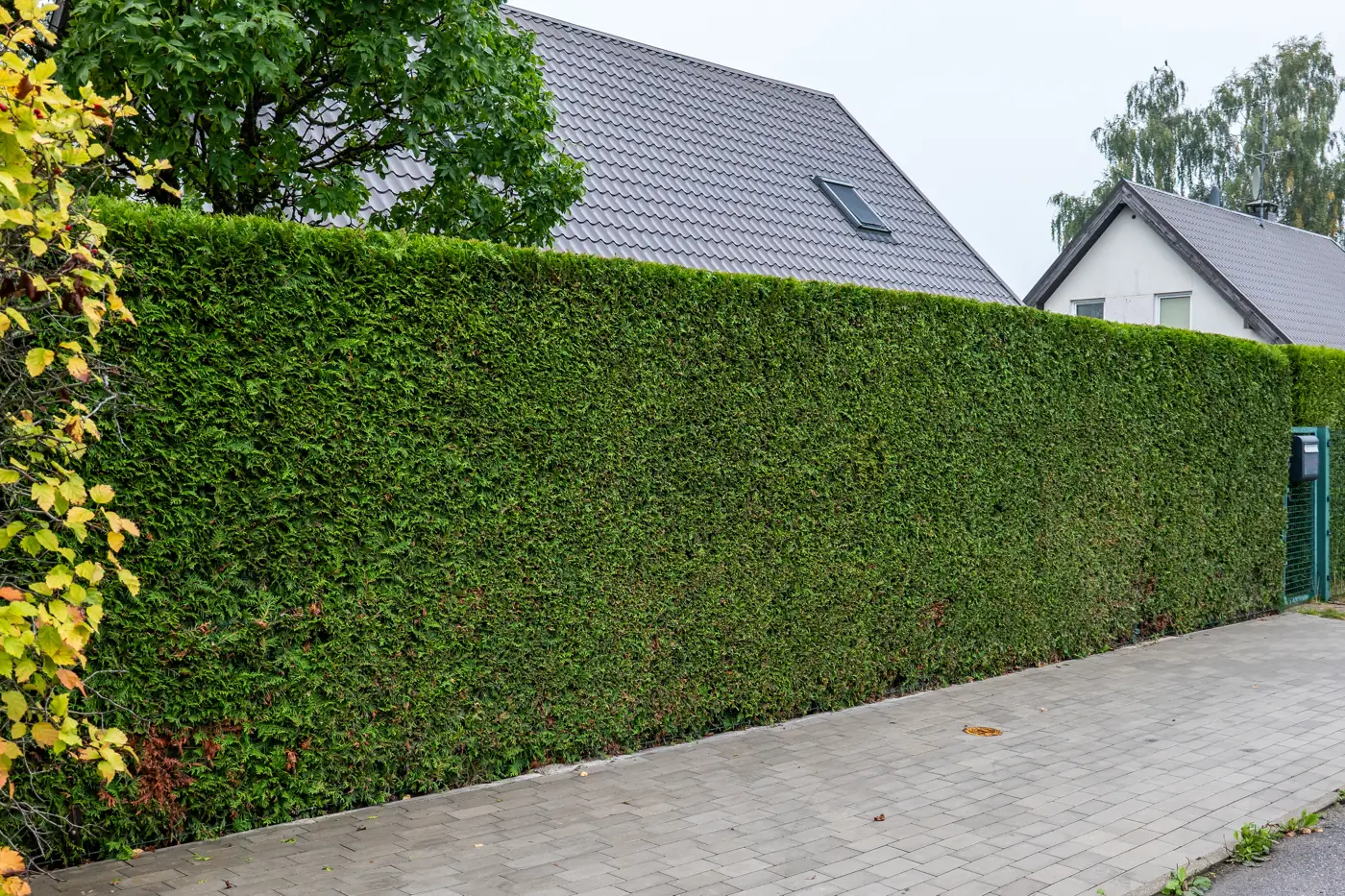
What is a conifer tree and what is Leylandii?
A conifer tree is a cone-bearing, woody plant that usually has needle-like or scale-like leaves. Conifers are mostly evergreen, holding their foliage all year, which makes them excellent for hedging and screening. The group includes pines, spruces, yews and cypresses. In gardens, evergreen conifers provide year-round cover, particularly along exposed boundaries where a deciduous hedge would lose its screening in winter.
Leylandii (x Cuprocyparis leylandii) is a hybrid conifer, a cross between the Monterey cypress and the Nootka cypress. It was first raised in the late 19th century and has become the go-to choice for a fast conifer hedge in Britain. Its hybrid parentage contributes to the vigorous growth that makes Leylandii useful for hedging but demanding to maintain. It is sometimes called Leyland cypress, and its golden form is known as Castlewellan Gold.
Types of conifer and Leylandii varieties for hedging
When people search for 'types of conifer', they often mean conifers suitable for hedging. Leylandii is the most popular, but other conifer hedging choices include yew (Taxus baccata), western red cedar (Thuja plicata) and Lawson cypress (Chamaecyparis lawsoniana). Each has a different growth rate and character. Yew is slower but can be clipped into precise shapes, while Thuja has a softer, aromatic foliage.
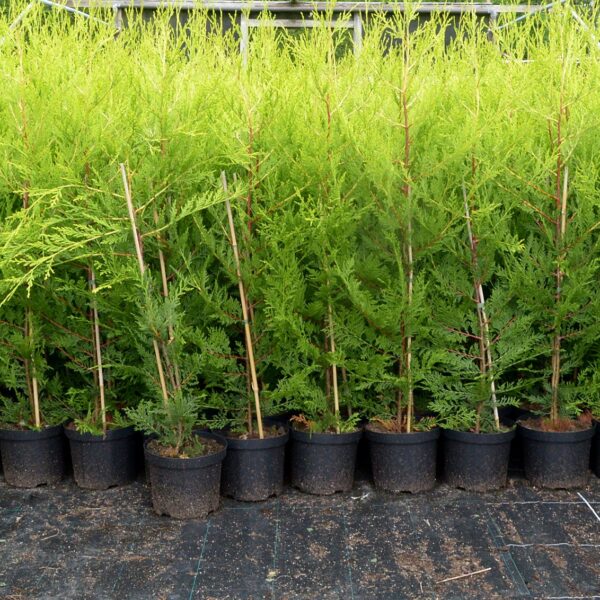
Leylandii itself comes in two main forms. Green Leylandii has dense, dark green sprays of foliage and is usually the lower-cost choice when planting a long hedge. Castlewellan Gold is a golden Leylandii with bright yellow-green new growth that matures to bronze-gold in winter. It grows slightly slower than the green form, reaching about 45 to 60 cm a year, and adds a warmer tone to a hedge.
Where and how to grow Leylandii in the UK
Leylandii grows in a wide range of garden soils, provided the roots are not left sitting in water. It grows in clay, chalk, sand and loam, as long as the ground is not waterlogged. It tolerates exposed sites and coastal winds, though in very exposed coastal gardens the foliage can scorch. Full sun is ideal, but it will also grow in partial shade. Avoid deep shade, where growth becomes thin and leggy.
Leylandii is hardy across the whole of the UK. It withstands temperatures down to -15°C once established. Newly planted conifers can suffer in prolonged cold winds, so a temporary windbreak of horticultural fleece or netting is useful in the first winter if your site is exposed.
Shop the plants in this guide
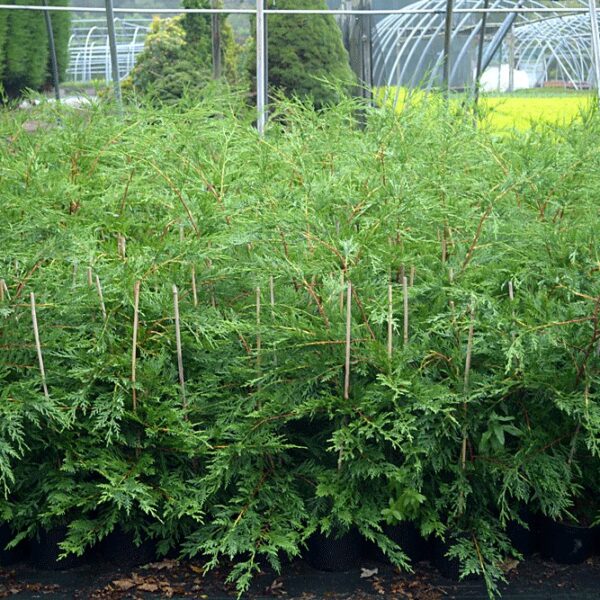
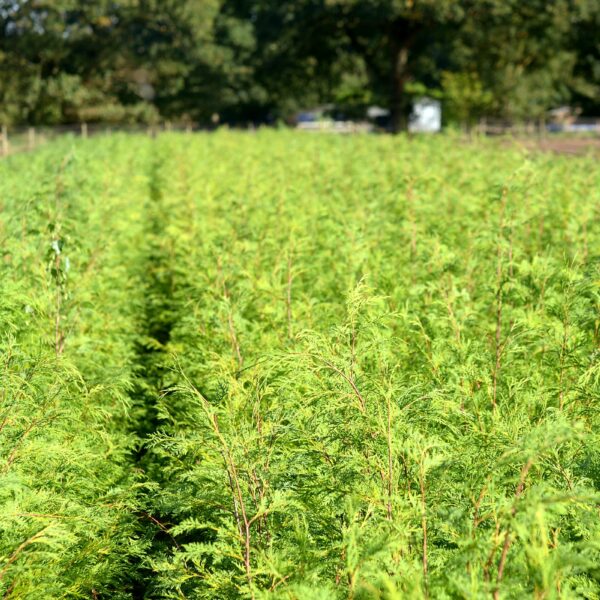
Our Leylandii range includes pot-grown and bare root green Leylandii in sizes from 40 cm to 150 cm, plus the golden Castlewellan Gold variety for a brighter hedge.
How to plant a Leylandii hedge step by step
Planting Leylandii correctly gives it the best start and reduces future problems. The ideal planting time for pot-grown Leylandii is any time the ground is workable, but autumn or spring are best. Bare root Leylandii must be planted between November and March, when the plants are dormant. Follow these steps for a healthy hedge.
- Clear the planting strip of weeds and grass at least 60 cm wide.
- Dig a trench 40 to 50 cm deep and 60 cm wide for a single row. For a double row, make the trench 90 cm wide.
- Fork the base of the trench to break up any compaction. Mix the excavated soil with well-rotted organic matter such as garden compost.
- Soak the root ball or bare roots in a bucket of water for 10 to 15 minutes before planting.
- Set each plant in the trench at the same depth it was growing before. Look for the soil mark on the stem. Do not bury the stem deeper.
- Backfill around the roots, firming gently with your heel as you go. Water thoroughly after planting.
- Apply a 5 to 7 cm layer of mulch, such as bark chips, around the plants, keeping it clear of the stems.
Leylandii spacing and sizing for a dense hedge
Spacing depends on the size of plants you start with and how quickly you want a solid screen. The table below shows recommended planting distances for different plant sizes.
| Plant size at planting | Spacing for a single row | Spacing for a double row (staggered) |
|---|---|---|
| 40 to 60 cm | 45 to 60 cm apart | 60 cm between rows, 75 cm between plants |
| 60 to 90 cm | 60 to 75 cm apart | 75 cm between rows, 90 cm between plants |
| 90 to 120 cm | 75 to 90 cm apart | 90 cm between rows, 100 cm between plants |
| 120 to 150 cm | 90 to 100 cm apart | 100 cm between rows, 120 cm between plants |
Watering and feeding Leylandii
Newly planted Leylandii need consistent watering for the first two growing seasons. In dry spells, water deeply once or twice a week rather than little and often. A thorough soak encourages roots to grow downwards. Established Leylandii hedges are drought-tolerant, but a long dry summer can slow growth and cause browning at the tips.
Feeding is not essential, but an annual application of a balanced general-purpose fertiliser in early spring will boost growth and colour. Use a granular fertiliser such as Growmore at about 70 g per square metre, scattered along the base of the hedge and watered in. Avoid high-nitrogen feeds late in the season, which can produce soft growth vulnerable to frost.
When to trim Leylandii and conifer hedge: a month-by-month guide
The key rule is to trim at least twice a year, in late spring and late summer. The final trim should be done by early September so new growth has time to harden before frosts. Leave routine trimming until the growing season, when the hedge can recover more readily. Avoid cutting during hard frost, and check carefully for active bird nests before starting work.
| Month | Action |
|---|---|
| January | No trimming. Check for snow damage and shake off heavy snow. |
| February | No trimming. Prepare tools for the season ahead. |
| March | No trimming. Nesting birds may be present from late March. |
| April | First trim of the year. Cut sides lightly; reduce height if needed. |
| May | Trim if growth is strong. Avoid cutting into old wood. |
| June | Second trim often needed. Keep sides vertical or slightly tapered. |
| July | Trim if necessary. Check for nests before starting. |
| August | Last main trim. Shape the hedge for winter. |
| September | Light tidy-up trim only, by early September. |
| October | No trimming. Let the hedge settle before winter. |
| November | No trimming. Plant bare root Leylandii this month. |
| December | No trimming. Check ties on young plants. |
Common problems and fixes for Leylandii hedges
Leylandii is generally trouble-free, but a few issues can arise. The most common is browning of the inner foliage. This is natural shading; the inner leaves die as the outer canopy blocks light. Regular trimming keeps the hedge narrow enough for light to reach the interior.
Conifer aphid (Cinara cupressi) can cause yellowing and dieback. Look for small greyish insects and sooty mould on the stems. Check affected shoots for live aphids and encourage natural predators. If treatment is needed, choose a product specifically approved for the pest and plant, and follow its label instructions. Honey fungus can attack Leylandii, causing sudden death of individual plants. There is no chemical control; remove affected plants and as much root as possible, and do not replant with woody plants in the same spot.
If a Leylandii hedge is cut back too hard into old brown wood, it will not regrow. The only solution is to replace the plant or live with the gap. This is why regular, light trimming is essential.
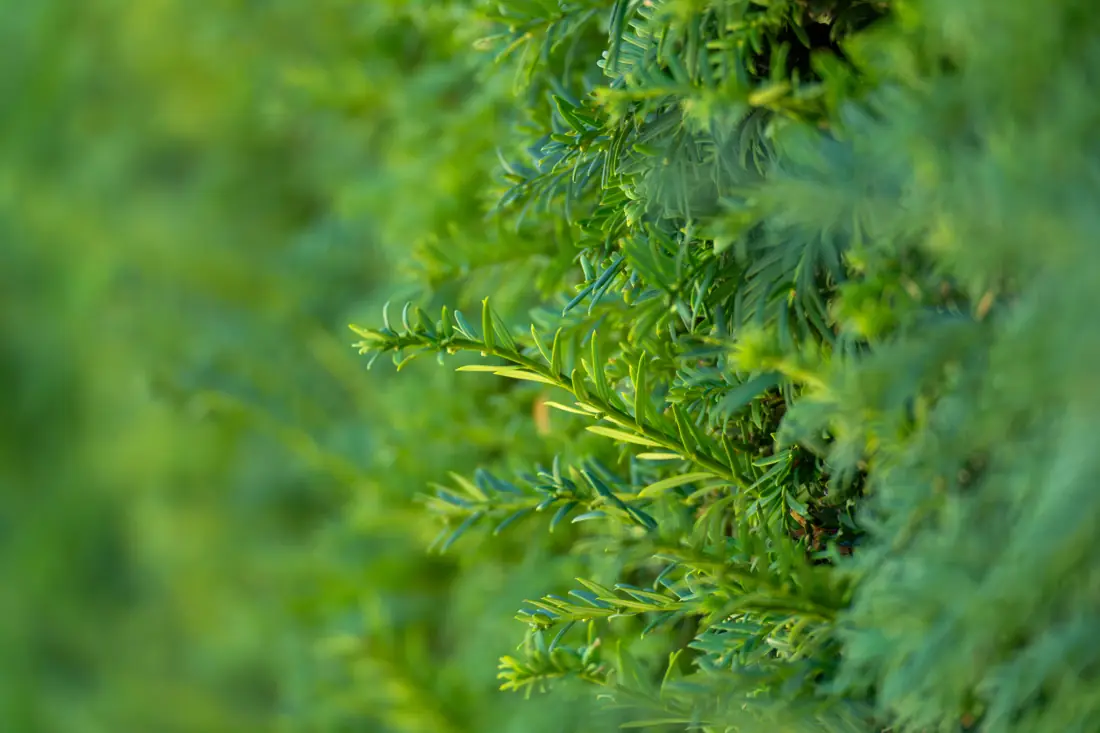
Leylandii law UK: is it illegal to plant a Leylandii hedge?
It is not illegal to plant a Leylandii hedge. There is no law banning any particular plant species. However, Part 8 of the Anti-social Behaviour Act 2003 gives local councils the power to deal with high hedges. If an evergreen hedge grows over 2 metres tall and blocks reasonable enjoyment of a neighbour's property, the neighbour can complain to the council. The council can then issue a notice requiring the hedge owner to reduce the height and keep it below a specified level.
To avoid disputes, keep your Leylandii hedge trimmed to a height that does not overshadow neighbouring windows or gardens. If you are planting a new hedge, consider the mature height and plant far enough inside your boundary so that the hedge does not encroach on your neighbour's land. Good communication with neighbours before planting can prevent problems later.
Design ideas with Leylandii and conifers
Leylandii is most often used as a boundary hedge for privacy and wind protection. It makes an excellent backdrop for mixed borders, where its dark green foliage sets off flowering shrubs and perennials. For a more formal look, trim it into a crisp rectangular shape. A tapered hedge, wider at the base than the top, allows light to reach the lower branches and prevents bare patches.
Golden Leylandii (Castlewellan Gold) can be used as a specimen conifer tree in a lawn or as a bright accent in a conifer planting. It also works well in a mixed conifer hedge with green Leylandii for a two-tone effect. Dwarf conifers in pots and borders can complement a Leylandii hedge by adding contrasting textures and shapes at ground level.
Buying Leylandii hedge plants
When you buy Leylandii, you can choose between pot-grown and bare root plants. Pot-grown Leylandii can be planted year-round and establish quickly. Bare root Leylandii are available from November to March and are more economical, especially for long hedges. Grade B bare root plants are a budget option with slightly smaller or less uniform plants that will catch up quickly with good care.
The size you choose depends on your budget and how quickly you want a screen. Smaller plants (40 to 60 cm) are cheaper and establish rapidly, often catching up with larger plants within a few years. Larger plants (120 to 150 cm) give an instant effect but need more careful watering and staking.
Leylandii root management and protecting boundaries
When planting leylandii hedging plants, the focus is often on height and screening, but root spread deserves equal attention. A leylandi tree can develop a fibrous root system that extends horizontally beyond the drip line of the canopy. On heavy clay soils common in parts of the UK, roots tend to stay shallower and spread wider in search of moisture and nutrients. On free-draining sandy or chalk soils, they may run deeper but still reach several metres from the trunk. This matters most when you position leylandii conifers near walls, drives, patios or underground services.
A purpose-made root barrier can help direct root growth away from a sensitive boundary, although it cannot guarantee protection from roots or soil movement. Barriers need to be suitable for the site and installed without leaving gaps or restricting the hedge's root system excessively. Near buildings, drains or established trees, seek professional advice on the barrier's position and depth rather than relying on a standard measurement. Cutting established Leylandii roots can weaken the hedge and increase the risk of wind damage, so substantial root pruning should be assessed by a qualified arborist before work begins.
Leylandii roots can exploit existing weaknesses in paving and drains, while water taken from shrinkable clay soil may contribute to ground movement near foundations during dry weather. The risk depends on soil conditions, building foundations, hedge size and distance from the property. There is no single safe planting distance that applies to every garden. Before planting Leylandii close to a house or other substantial structure, have the site assessed if there are concerns about clay shrinkage or existing damage. English yew is a slower-growing alternative for a boundary that needs less frequent trimming, although its roots and eventual size must still be considered.
Neighbour relations often sour over roots long before the hedge height becomes an issue. Roots from leylandii trees for sale planted on your side can cross the boundary and draw moisture from a neighbour’s flower beds or vegetable plot. There is no specific ‘root law’ equivalent to the High Hedges legislation, but common law allows a neighbour to cut back roots that encroach onto their property, provided they do not destabilise the tree. The prudent approach is to discuss planting plans early, offer to install a root barrier, and agree a shared maintenance schedule. This is especially important when you are establishing a leylandi hedge that will quickly become a dominant landscape feature.
Leylandii wind resilience and storm-proofing your hedge
Leylandii hedging is prized for creating fast shelterbelts, yet the same dense foliage that blocks wind can make a hedge vulnerable to storm damage if it is not managed correctly. A solid wall of leylandii conifers acts like a sail, taking the full force of gusts and transferring that load to the root plate. In exposed coastal or upland sites, an unthinned leylandii hedge can rock in the wind, gradually loosening the roots and creating a ‘wind rock’ effect that stunts growth and opens gaps at the base. The key to a storm-resilient conifer hedge is to allow some air to filter through, reducing the pressure differential.
Shaping makes a measurable difference. Taper the hedge so the base is wider than the top, a profile sometimes called a batter or ‘A-frame’ profile. This lowers the centre of gravity, exposes less foliage to wind loading at height, and allows light to reach the lower branches, keeping them green and functional. For a leylandi hedge that already has a flat, vertical face, gradually reduce the width of the upper third over two or three trimming sessions. Never cut back into old brown wood, as leylandii does not regenerate from bare stems. Aim to maintain at least 5 to 10cm of green growth on all sides.
The timing of trimming directly affects wind firmness. A light trim in early spring, followed by a second trim in mid to late summer, encourages dense but not overly heavy regrowth before autumn gales arrive. The last cut should be completed by early September so new shoots have time to harden off. Soft, sappy growth produced after a late trim is easily shredded by wind and frost. If you are buying hedging conifers for a windy site, look for well-rooted container-grown leylandii hedging plants rather than bare-root stock, as the undisturbed root ball establishes faster and anchors the plant more securely in the first winter.
Young Leylandii on exposed sites may benefit from temporary windbreak mesh while their roots establish. Fix the mesh securely on the windward side, leaving enough clearance to prevent it rubbing against the foliage. Larger newly planted specimens may need temporary support, particularly where the soil is loose or the site catches strong gusts. Remove supports once the plants are firmly rooted. After a storm, check for leaning stems, lifted root plates and broken branches. Firm gently around loosened young plants and remove damaged growth without cutting into bare brown wood. A hedge kept at a manageable height, with a broad base and narrower top, is easier to maintain and less exposed to wind loading than one allowed to grow unchecked.
Leylandii FAQs
Common questions
Is it illegal to plant a Leylandii hedge?
No, it is not illegal to plant a Leylandii hedge. There is no law in the UK that bans planting any specific hedge species. However, under the Anti-social Behaviour Act 2003, neighbours can complain to the council if an evergreen hedge over 2 metres tall blocks light to their property.
What are the disadvantages of Leylandii?
The main disadvantage is its fast growth, which means it needs trimming at least twice a year. It does not regrow from old brown wood, so you cannot cut it back hard to reduce size. Leylandii can also cause disputes with neighbours if it grows too tall and blocks light.
Why avoid Leyland cypress?
Some gardeners avoid Leyland cypress because of its reputation for getting out of control. If you cannot commit to regular trimming, it will quickly become too large. It is not suitable for small gardens or for planting close to buildings, where its vigorous roots can cause problems in dry soils.
When should you not cut Leylandii?
You should not cut Leylandii between October and March. Cutting in autumn or winter leaves wounds that are slow to heal, and frost can damage the cut stems. Also avoid cutting during the bird nesting season, which usually runs from March to August, unless you have checked there are no active nests.
When to trim Leylandii?
Trim Leylandii at least twice a year, in late spring (April to May) and late summer (August). A light tidy-up trim can be done in early September. The last trim should be completed by early September so new growth hardens before winter.
When to cut conifer hedge?
Cut a conifer hedge such as Leylandii in late spring and again in late summer. The exact months are April to August, with the final cut no later than early September. Never cut conifer hedges in autumn or winter, as this can lead to frost damage.
When to prune Leylandii?
Prune Leylandii lightly in April or May for the first cut of the year, and again in August. Pruning is the same as trimming for Leylandii; the aim is to keep the hedge dense and green by cutting back new growth before it gets too long.
When to cut Leylandii hedge?
Cut a Leylandii hedge twice a year, in late spring and late summer. The first cut is usually in April or May, and the second in August. Always finish cutting by early September to avoid frost damage to new shoots.
When to trim conifer hedge?
Trim a conifer hedge in late spring and late summer. For Leylandii, this means April to May and August. A light trim in early September is acceptable, but avoid any trimming from October to March.
What's a conifer tree?
A conifer tree is a cone-bearing, usually evergreen tree with needle-like or scale-like leaves. Common examples include pines, spruces, firs and cypresses. Conifers are widely used in UK gardens for hedging, screening and as specimen trees.