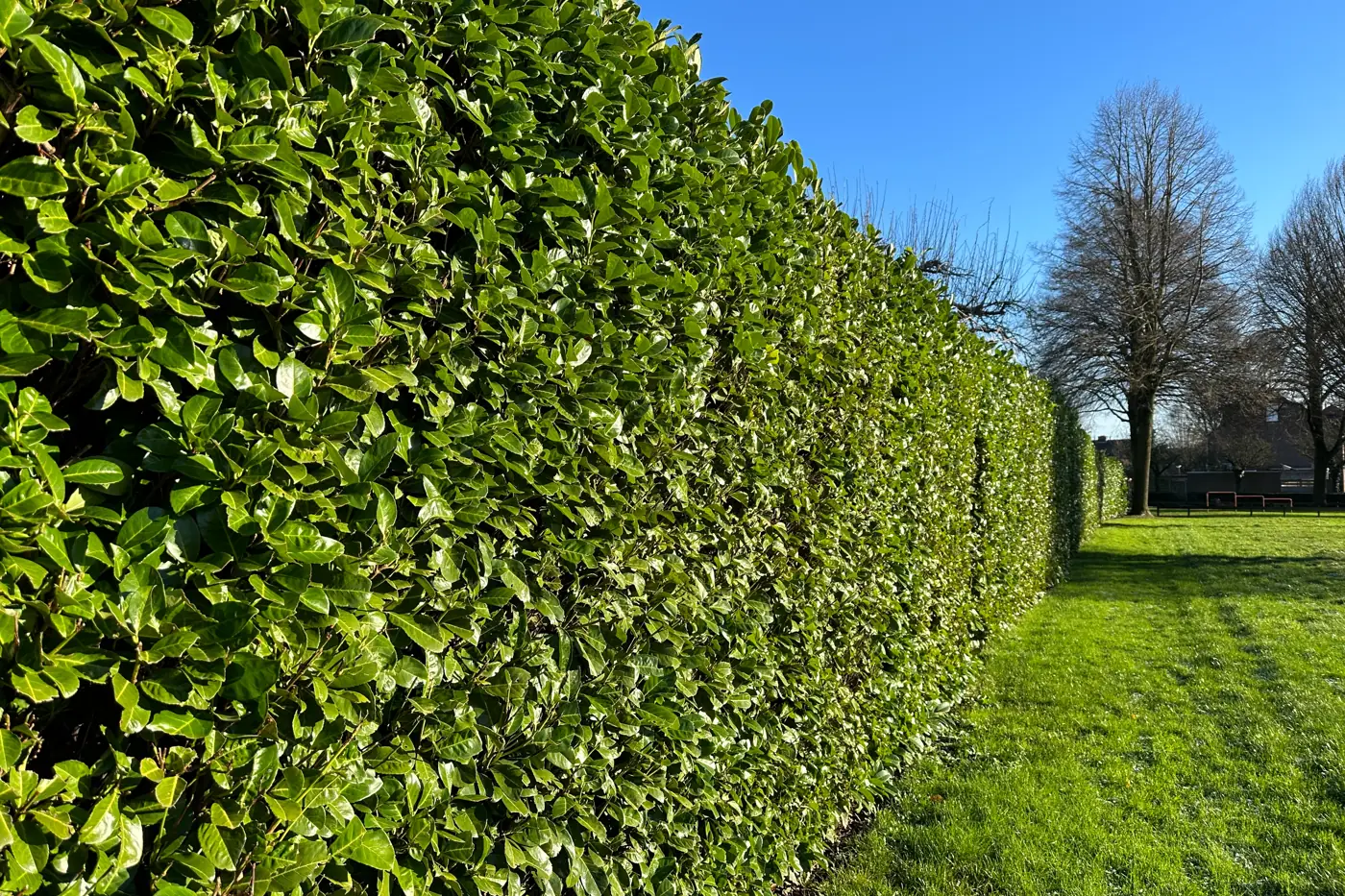
What is cherry laurel?
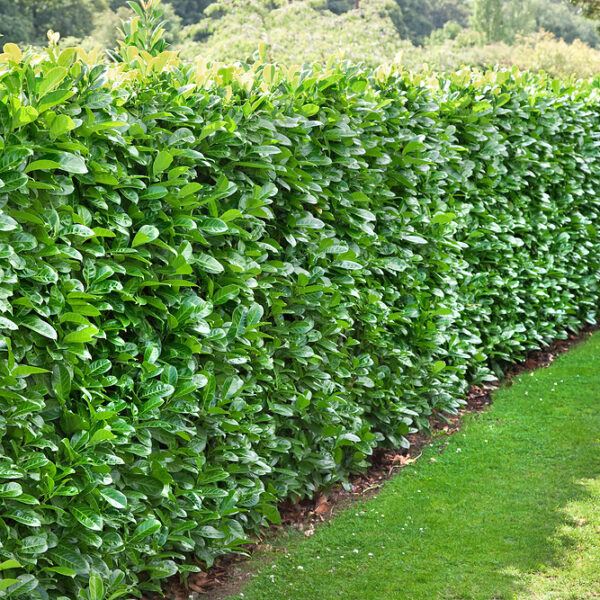
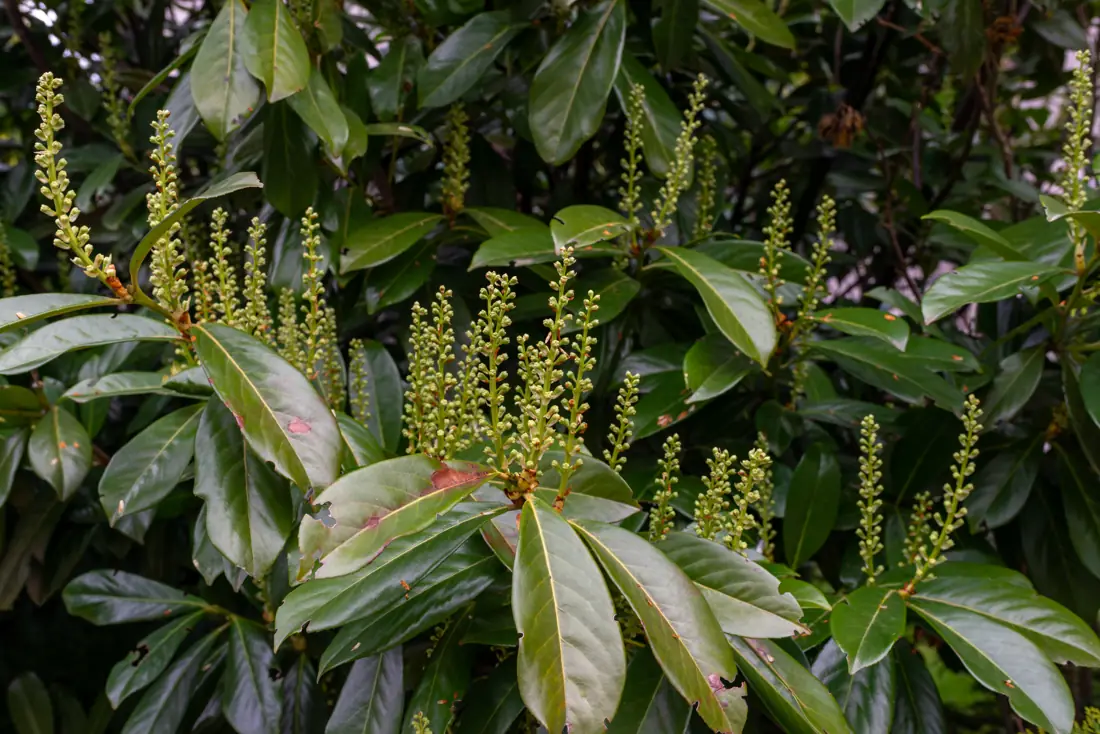
Cherry laurel, Prunus laurocerasus, is a vigorous, broadleaf evergreen shrub native to south-eastern Europe and south-western Asia. It belongs to the rose family and is prized in the UK for its ability to form a thick, year-round screen quickly. The large, oblong leaves are a rich, glossy dark green, similar in shape to bay but with a finer serration. In spring, upright spikes of small, fragrant white flowers appear, followed by small cherry-like fruits that ripen to black.
The common name 'cherry laurel' can cause confusion. It is different from culinary bay laurel (Laurus nobilis), but it does belong to the same Prunus genus as edible cherries. Cherry laurel fruits are not suitable for eating. All parts of the plant contain cyanogenic compounds, so the leaves and berries should never be eaten. Despite this, it remains one of the most popular hedging plants in the UK because of its toughness, shade tolerance and rapid establishment.
What's the difference between a laurel and a cherry laurel?
In UK garden centres, 'laurel' usually refers to cherry laurel (Prunus laurocerasus), but there are two other plants commonly called laurel: Portugal laurel (Prunus lusitanica) and bay laurel (Laurus nobilis). Each has distinct characteristics.
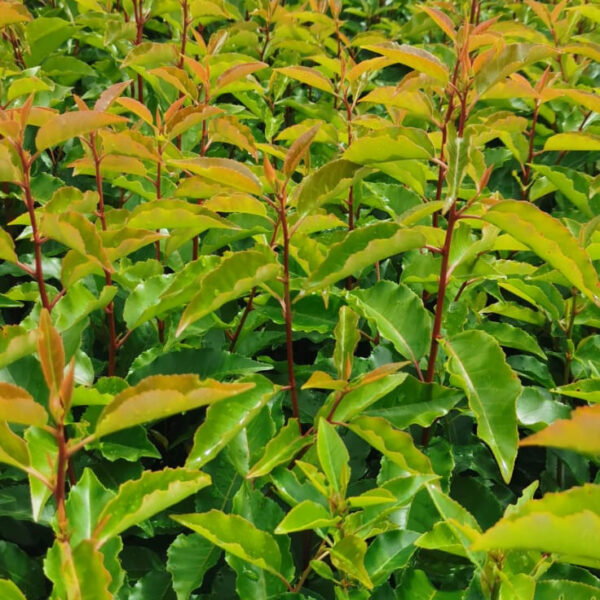
Cherry laurel has the largest leaves, up to 15cm long, and a broad, rounded habit. It is the fastest growing of the three, making it the top choice for a quick privacy hedge. Portugal laurel has smaller, darker, more slender leaves with reddish stems and a neater, more formal appearance. It is slower growing but more tolerant of wind and chalky soils. Bay laurel is the culinary bay, with aromatic leaves used in cooking. It is less vigorous and not as dense, so it is less suited to heavy screening.
For hedging, cherry laurel and Portugal laurel are the two main options. Cherry laurel is better for rapid cover in shade, while Portugal laurel suits exposed sites and gardeners who want a tidier, more refined look with less frequent trimming.
How quickly does a cherry laurel hedge grow?
Under typical UK conditions, cherry laurel grows between 30 and 60cm per year once established. In the first year after planting, growth is slower as the roots settle in. By the second or third year, you can expect the full annual rate. A hedge planted with 90 to 120cm tall plants can reach 2 metres within two to three growing seasons with good aftercare.
Growth rate depends on soil, light and moisture. Cherry laurel is unusual among hedging plants in that it maintains strong growth even in deep shade. In full sun, it grows denser and faster. In very dry, compacted or waterlogged soil, growth will be reduced. Regular watering during the first two summers and an annual mulch will help achieve the fastest possible establishment.
Shop the plants in this guide
Our cherry laurel hedging is available in three sizes: 40-60cm in a 9cm pot, plus 60-90cm and 90-120cm plants in 2 litre pots. Each option is sold as one plant. The smaller size is useful for planting longer boundaries, while the taller plants give more height from the outset. Portuguese laurel is also available in 40-60cm 9cm pots and 60-90cm 2 litre pots if you prefer smaller leaves and a more formal clipped appearance.
How to plant a cherry laurel hedge step by step
Planting correctly gives your laurel hedge the strongest start. The best time to plant pot-grown cherry laurel is autumn or spring, when the soil is moist and temperatures are mild. Avoid planting when the ground is frozen or waterlogged.
Before digging, lay out the plants along the proposed hedge line to check the spacing. Keep the pots nearby so the rootballs stay moist, then plant as follows:
- 1. Mark the line of your hedge with string and canes. For a straight hedge, use a taut line; for curves, lay a garden hose as a guide.
- 2. Dig a trench 60 to 90cm wide and 30 to 45cm deep, depending on the rootball size. Keep the topsoil separate.
- 3. Fork over the base of the trench to break up any compaction. If drainage is poor, add a 5cm layer of horticultural grit.
- 4. Mix well-rotted organic matter, such as garden compost, into the excavated soil. Do not use fresh manure.
- 5. If using a mycorrhizal fungi product such as RHS Rootgrow, follow the pack instructions and apply it directly where it will contact the roots. It is an optional planting aid rather than a substitute for suitable soil conditions and regular watering.
- 6. Set each plant at the same depth it was in its pot. Use a cane across the trench to check the level.
- 7. Backfill with the improved soil, firming gently with your heel as you go. Do not compact it hard.
- 8. Water thoroughly, soaking the root zone. Apply a 5 to 8cm mulch of bark or compost, keeping it clear of the stems.
Cherry laurel hedge spacing: how many plants per metre
Correct spacing ensures your hedge fills out evenly without overcrowding. The table below shows recommended spacings for different plant sizes and desired hedge densities.
For a single-row hedge, allow roughly 35 to 100cm between plants, depending on their starting size and how quickly you want the gaps to close. Smaller 40-60cm plants can be set closer together, while larger 90-120cm specimens need more room. For a wider screen, use two staggered rows with approximately 75 to 90cm between rows, adjusting the spacing to allow the plants to develop. Cherry laurel is poisonous to grazing animals and should never be relied upon as a livestock barrier.
| Plant size at planting | Plants per metre (single row) | Final hedge width |
|---|---|---|
| 40-60cm (9cm pot) | 2 to 3 | 60-90cm |
| 60-90cm (2 litre pot) | 1.5 to 2 | 90-120cm |
| 90-120cm (2 litre pot) | 1 to 1.5 | 120-150cm |
Watering and feeding a laurel hedge
Newly planted laurel hedges need consistent watering for the first two growing seasons. Water deeply once or twice a week in dry weather, rather than little and often. A thorough soak encourages roots to grow downwards, making the hedge more drought-resistant later. In prolonged hot, dry spells, even established hedges benefit from a deep watering every two to three weeks.
Feeding is straightforward. In early spring, apply a general-purpose granular fertiliser, such as fish, blood and bone, at the rate recommended on the packet. A second, lighter feed in early summer supports the flush of new growth after trimming. Avoid high-nitrogen feeds late in the season, as soft late growth can be damaged by frost. An annual mulch of well-rotted compost or leaf mould in spring feeds the soil, conserves moisture and suppresses weeds.
When to prune a laurel hedge: month-by-month timing
Timing is key to keeping a laurel hedge neat and healthy. The best time to prune is after flowering, from late spring through to late summer. Pruning too late in autumn can leave soft new growth exposed to winter frost. Always check for nesting birds before you start; it is illegal to disturb active nests.
The table below gives a month-by-month guide to pruning cherry laurel in the UK.
| Month | Pruning advice |
|---|---|
| January | Do not prune. Frost can damage cut stems. |
| February | Do not prune. Wait until risk of hard frost has passed. |
| March | Light tidy if necessary, but better to wait until after flowering. |
| April | Flowering begins. Avoid pruning if you want flowers and berries. |
| May | Main pruning window opens after flowers fade. Ideal for secateur work. |
| June | Prime time for trimming. Growth is strong and wounds heal quickly. |
| July | Continue trimming. Finish any major reshaping by end of month. |
| August | Last chance for a light trim. Do not cut hard after mid-August. |
| September | Avoid pruning. New growth may not harden before frost. |
| October | Do not prune. Let the hedge settle for winter. |
| November | Do not prune. Clear fallen leaves from the base to prevent rot. |
| December | Do not prune. Plan next year's trimming schedule. |
How to trim a laurel hedge for the best finish
Laurel leaves are large, and hedge trimmers cut through them, leaving brown, ragged edges that can spoil the look for weeks. For the neatest finish, use sharp secateurs to cut individual stems just above a leaf node. This takes longer but keeps the foliage green and unmarked. If you use a hedge trimmer, go back afterwards with secateurs to snip out any damaged leaves.
Start by removing dead, damaged or crossing branches. Then cut back the sides, keeping the hedge slightly wider at the base than the top. This 'batter' lets light reach the lower branches, preventing bare patches. Finally, reduce the height. Aim to remove no more than one-third of the total growth in any one session. If the hedge has become overgrown, spread hard pruning over two or three years, cutting one side at a time.
Is laurel poisonous? A practical guide for gardeners and pet owners
Cherry laurel contains cyanogenic compounds that can release cyanide when plant material is chewed or digested. Its leaves, stems and seeds are poisonous, and the cherry-like fruits should never be treated as edible. Do not rely on their bitter taste to prevent poisoning. Young children may be attracted to fallen fruit, while pets and grazing animals can chew foliage or discarded cuttings. Keep children away from the berries, remove accessible fallen fruit and seek urgent medical or veterinary advice if ingestion is suspected.
For gardeners, the main practical risk comes from shredding large volumes of laurel prunings in a confined space. The crushed leaves release cyanide gas, which can cause respiratory irritation. Always shred laurel in a well-ventilated area, or better still, compost whole leaves or dispose of them via green waste collection. Do not burn laurel clippings on a bonfire, as the smoke can also be harmful.
Livestock, particularly ruminants, are at higher risk. Do not plant cherry laurel where cattle, sheep, goats or horses can browse it. If you keep chickens, fence off the hedge base to prevent them pecking at fallen berries.
Common problems with cherry laurel and how to fix them
Cherry laurel is generally robust, but a few issues can arise, particularly on stressed plants.
- Powdery mildew: A white, dusty coating on leaves, often in dry soil and stagnant air. Improve watering, mulch well and thin out congested growth to increase airflow. Fungicides are rarely needed.
- Shot hole disease: Small, round holes in leaves, caused by a fungal or bacterial infection. Rake up and dispose of fallen leaves. Prune to improve air circulation. Avoid overhead watering.
- Leaf spot: Brown or purple spots on foliage. Usually cosmetic. Remove affected leaves and feed the hedge to boost vigour.
- Yellowing leaves: Often a sign of waterlogging, drought or nutrient deficiency. Check drainage, water deeply during dry spells and apply a balanced fertiliser in spring.
- Vine weevil: Notches in leaf edges and root damage from larvae. Use nematode biological controls in late summer and autumn. Trap adults with sticky barriers on pots.
- Scale insects: Small, brown, limpet-like bumps on stems and leaf undersides. Wipe off with soapy water or apply a winter tree wash.
How invasive is cherry laurel?
Cherry laurel can spread beyond gardens into woodland, where its dense evergreen foliage shades out smaller native plants. Birds eat the fruits and carry seeds into surrounding areas, allowing seedlings to establish beneath trees and along woodland edges. It is recognised as a potentially invasive non-native plant, particularly in parts of southern England. Cherry laurel is not currently listed under Schedule 9 of the Wildlife and Countryside Act 1981 in England and Wales, but its ability to spread into natural habitats remains an important consideration when deciding where to plant it.
In a garden setting, a well-maintained hedge is not considered invasive. The risk comes when hedges are left unpruned and allowed to fruit heavily, or when clippings are dumped in the countryside. To be a responsible gardener, trim your laurel hedge after flowering to remove developing fruits, and never fly-tip garden waste. If you live near a woodland or nature reserve, consider Portugal laurel as a less invasive alternative, or commit to annual trimming before berries form.
Design ideas: using laurel as a hedge, screen or shrub
Cherry laurel is most often used as a boundary hedge for privacy. Its dense, evergreen foliage blocks noise and wind effectively, making it a good choice for urban gardens and roadside plantings. Planted in a double row, it creates an almost solid barrier within three to four years.
Beyond the traditional hedge, laurel can be grown as a standalone shrub or small tree. Left unpruned, it develops a rounded, multi-stemmed form that works well in a woodland garden or as a backdrop to mixed borders. It can also be trained as a pleached screen, with a clear trunk and a flat canopy, ideal for raising the height of a boundary without taking up ground space.
In smaller gardens, ordinary cherry laurel can be kept to a manageable height through regular trimming, although its vigorous growth and broad leaves mean it needs sufficient space to develop. Allow room for the hedge to thicken without obstructing paths or neighbouring plants. For a narrower, more formal boundary, Portuguese laurel (Prunus lusitanica) is another option. Its smaller leaves, reddish stems and naturally tidier growth respond well to close clipping. Our range includes cherry laurel and Portuguese laurel, but no separate dwarf cherry laurel cultivars.
Buying advice: what to look for in a cherry laurel plant
When buying cherry laurel for hedging, look for plants with healthy, unblemished leaves and a well-developed root system. Pot-grown plants can be planted year-round, avoiding only frozen or waterlogged conditions. The most popular sizes for hedging are 60 to 90cm and 90 to 120cm tall plants in 2-litre pots. These strike a good balance between cost and establishment speed.
Smaller 9cm pot plants, typically 40 to 60cm tall, are more economical for large projects but take an extra year to reach screening height. Always check that the roots are not circling tightly in the pot; gently tease them out before planting. For the fastest screen, choose the largest size your budget allows, and invest in good soil preparation and mycorrhizal fungi.
Common questions
What is the disadvantage of cherry laurel?
The main disadvantage is that the leaves and berries are poisonous if eaten, so it is not ideal for gardens with livestock or very young children who might ingest plant material. The large leaves can also look ragged if cut with a hedge trimmer, requiring extra care when pruning. In some areas, it can be invasive if allowed to seed into woodland.
How quickly does a cherry laurel hedge grow?
Cherry laurel grows 30 to 60cm per year once established. With good soil preparation, watering and feeding, a hedge planted with 90 to 120cm plants can reach 2 metres in two to three years.
What's the difference between a laurel and a cherry laurel?
In UK gardening, 'laurel' usually means cherry laurel, Prunus laurocerasus. Portugal laurel, Prunus lusitanica, has smaller, darker leaves and a neater habit. Bay laurel, Laurus nobilis, is the culinary herb. Cherry laurel is the fastest growing and best for quick privacy screens.
How invasive is cherry laurel?
Cherry laurel can be invasive in UK woodlands if its seeds are spread by birds. It is listed on Schedule 9 of the Wildlife and Countryside Act, making it illegal to plant in the wild. A regularly trimmed garden hedge poses little risk, but you should remove developing fruits and never dump clippings in the countryside.
When to prune laurel hedge?
Prune cherry laurel after flowering, from late spring to late summer. May to July is ideal. Avoid pruning after mid-August, as new growth may not harden before winter frosts.
When to trim laurel hedge?
Trim your laurel hedge between May and August. Use secateurs for the neatest finish, as hedge trimmers can cut the large leaves and leave brown edges. Always check for nesting birds before starting.
Is laurel poisonous?
Yes, all parts of cherry laurel contain cyanogenic compounds and are toxic if eaten. The berries and leaves are the most harmful. Take care when shredding prunings, as crushed leaves can release cyanide gas. Do not plant where livestock can browse it.
Are laurel berries poisonous?
Yes, laurel berries are poisonous. They contain cyanogenic glycosides, which can release cyanide when digested. Children and pets are most at risk. Trim after flowering to prevent berries forming, and clear any fallen fruit from paths and lawns.
When to cut laurel hedge UK?
Late May to August is generally a suitable period for trimming cherry laurel in the UK, with May to July useful for the main cut once flowering has finished. Birds may still be nesting during these months, so inspect the hedge carefully before cutting and postpone work if you find an active nest. Avoid heavy pruning late in the season, as fresh shoots may not have enough time to harden before frost. In mild areas, a light tidy may be possible in early September if no active nests are present.
When to plant laurel hedge?
Plant pot-grown laurel hedges in autumn or spring, when the soil is moist and temperatures are moderate. Autumn planting gives roots time to establish before the following summer. Avoid planting in frozen or waterlogged ground.