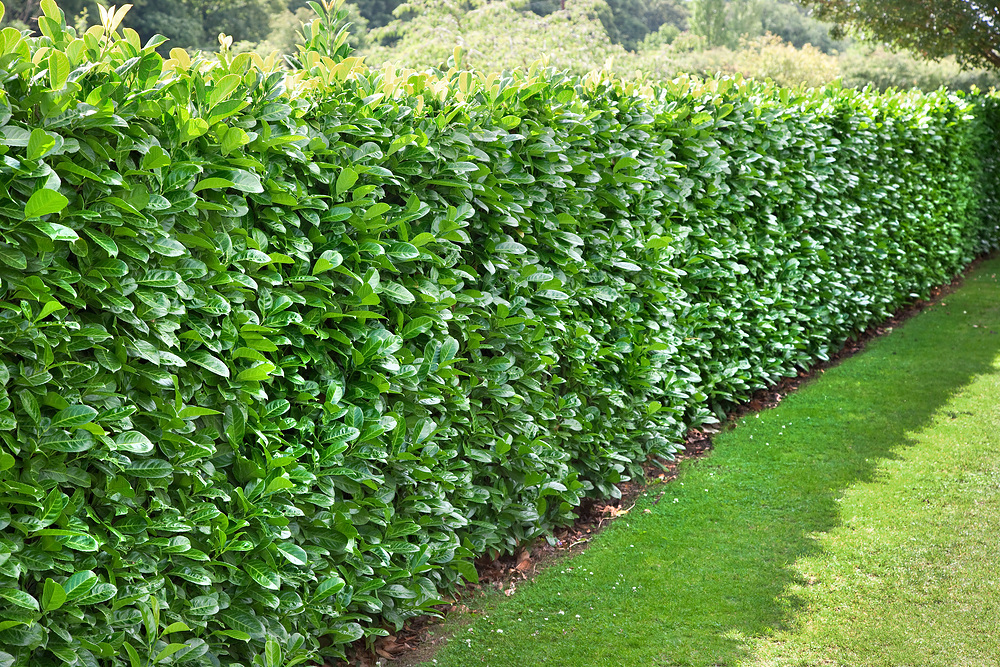
How tall does laurel grow?
Cherry laurel (Prunus laurocerasus) can reach an ultimate height of 5 to 8 metres, with a spread of 4 to 6 metres, if left to grow as a large shrub or small tree. Portuguese laurel (Prunus lusitanica) is a little more compact, eventually reaching 4 to 6 metres tall. In gardens, laurel is usually kept at 1.5 to 2.5 metres. This provides useful screening without making annual trimming too difficult, and regular cutting encourages leafy growth down towards the base.
The height your laurel hedge will reach depends on the variety, growing conditions and how often you prune. Both cherry and Portuguese laurel tolerate hard pruning, although a severely reduced hedge may take several growing seasons to regain its shape and density. Trimming regularly is easier than correcting a hedge that has grown too large.
Growth per year: cherry vs Portuguese laurel
Laurel is often planted where a boundary needs to fill out within a few growing seasons. Under reasonable conditions, cherry laurel puts on 30 to 60cm of new growth each year. Portuguese laurel is slightly slower, typically growing 20 to 40cm per year. Both are considered fast-growing evergreen hedging plants, but cherry laurel has the edge when you need a dense screen quickly.
Several factors influence the annual growth you actually see. Soil fertility, moisture, light levels and the age of the plant all play a part. Newly planted laurel often grows more slowly in its first year as it puts energy into root establishment, before speeding up in years two and three.
| Feature | Cherry laurel (Prunus laurocerasus) | Portuguese laurel (Prunus lusitanica) |
|---|---|---|
| Annual growth rate | 30 to 60cm | 20 to 40cm |
| Ultimate unpruned height | 5 to 8m | 4 to 6m |
| Typical hedge height | 1.5 to 2.5m | 1.5 to 2.5m |
| Leaf appearance | Large, glossy, bright green | Smaller, darker green, with red stems |
| Hardiness | Fully hardy in the UK | Fully hardy in the UK |
| Toxicity | Leaves and berries contain cyanogenic glycosides; harmful if eaten | Leaves and berries contain cyanogenic glycosides; harmful if eaten |
How tall a laurel hedge can get and the sensible height
A laurel hedge maintained at 1.5 to 2.5 metres gives good privacy while remaining reasonably manageable. Much of the trimming can be done with a long-reach hedge trimmer, although taller sections may still need suitable access equipment. Keeping the sides slightly narrower at the top helps light reach the lower leaves. Letting a laurel hedge grow much above 3 metres often leads to thin, leggy growth at the bottom and makes annual pruning a bigger job.
If you need a taller screen for a large garden or to block a two-storey view, cherry laurel is perfectly capable of reaching 3 to 4 metres as a hedge, provided you prune it regularly to keep the shape. Just bear in mind that very tall hedges may fall under the scope of high hedge legislation, so check with your local authority if you plan to let it grow above 2 metres on a boundary.
Which size to buy for privacy in year one
Choosing the right starting size makes a big difference to how quickly your hedge screens. Cherry laurel is available as 40 to 60cm plants in 9cm pots, 60 to 90cm plants in 2 litre pots, and 90 to 120cm plants in 2 litre pots. Portuguese laurel is offered at 40 to 60cm in 9cm pots and 60 to 90cm in 2 litre pots.
For privacy in the first year, start with the 90 to 120cm cherry laurel in 2 litre pots. These plants give useful low-level screening as soon as they are planted, although gaps will remain until the branches spread. The 60 to 90cm plants in 2 litre pots are a smaller starting option, while the 40 to 60cm plants in 9cm pots suit gardeners who can allow more time for the hedge to fill out. Establishment speed depends on spacing, soil, watering and growing conditions.
- 90 to 120cm cherry laurel: immediate waist-to-chest-height screen when planted.
- 60 to 90cm laurel: a useful starting size, with screening developing as the branches spread and meet.
- 40 to 60cm laurel: a smaller starting size that needs more growing seasons to develop a continuous screen.
How to make laurel grow faster
Getting your laurel off to a strong start is mostly about soil preparation and consistent aftercare. Start by loosening compacted ground, removing perennial weeds and watering the plants thoroughly after planting. RHS Rootgrow can be applied directly to the roots at planting time to introduce mycorrhizal fungi, which may help nutrient uptake as the roots establish. It will not compensate for poor drainage or a lack of watering.
Watering is the next priority. New laurel hedges need thorough watering every week during the first growing season, and more often in hot, dry spells. A generous mulch of bark or compost around the base (keeping it clear of the stems) locks in moisture and suppresses weeds. From the second spring onwards, an annual feed with a balanced, slow-release fertiliser in March or April will support steady growth. Avoid high-nitrogen feeds late in the season, as soft late growth can be damaged by frost.
- Use mycorrhizal fungi (RHS Rootgrow) at planting time to boost root development.
- Water deeply once a week in the first year, more often in dry weather.
- Apply a 5 to 7cm mulch layer to retain moisture and reduce weed competition.
- Feed with a balanced, slow-release fertiliser each spring.
- Keep the area around the hedge weed-free for the first two years.
Spacing and its effect on fill
Spacing your laurel plants correctly helps the hedge fill out evenly without overcrowding. For a single row hedge, space cherry laurel 60 to 90cm apart; Portuguese laurel can be planted slightly closer at 50 to 75cm. If you want a thicker hedge, plant a staggered double row with the same spacing within each row and 40 to 60cm between the rows.
Closer spacing encourages the plants to knit together more quickly, but it also increases competition for water and nutrients. Wider spacing is more economical for a longer run of hedging and still produces a dense hedge, just a little more slowly. The table below shows how many plants you need for common hedge lengths.
| Hedge length | Single row (every 75cm) | Double row (every 75cm, staggered) |
|---|---|---|
| 5 metres | 7 plants | 14 plants |
| 10 metres | 14 plants | 28 plants |
| 20 metres | 27 plants | 54 plants |
Common questions
How fast does cherry laurel grow in the UK?
Cherry laurel typically grows 30 to 60cm per year in the UK once established. In the first year after planting, growth is often slower while the roots settle in. Good soil preparation, regular watering and suitable feeding give the hedge a better chance of reaching this growth rate, although the amount of new growth will still vary with the weather and growing conditions.
How quickly does Portuguese laurel grow compared to cherry laurel?
Portuguese laurel grows at a rate of 20 to 40cm per year, making it slightly slower than cherry laurel. It still forms a dense evergreen hedge relatively quickly, and many gardeners prefer its neater, darker green leaves and red-tinged stems. Both are excellent choices for a fast, formal screen.
How high can a laurel hedge legally be?
There is no set legal height limit for hedges in the UK, but under the Anti-social Behaviour Act 2003, local councils can investigate complaints about evergreen hedges over 2 metres high that block light or cause unreasonable loss of enjoyment. Keeping a laurel hedge at 1.5 to 2.5 metres avoids most disputes while still providing good privacy.
Can I make my laurel hedge grow faster?
Yes, you can encourage faster growth by planting with mycorrhizal fungi, watering thoroughly every week in the first growing season, mulching with bark or compost, and feeding with a balanced slow-release fertiliser each spring. Keeping the area free of weeds and grass for the first two years also reduces competition and helps the hedge establish more quickly.
Is laurel poisonous to people or pets?
Yes, all parts of cherry laurel and Portuguese laurel contain cyanogenic glycosides, which can release cyanide when the leaves or berries are chewed. The plants are harmful if eaten by people, dogs, cats or livestock. Wear gloves when pruning, collect the clippings promptly and keep them away from pets and grazing animals. Seek veterinary advice immediately if you suspect an animal has eaten laurel.
When is the best time to plant laurel hedging?
Container-grown laurel can be planted at any time of year, provided the ground is not frozen or waterlogged. The best results come from planting in autumn (September to October) or spring (March to April), when the soil is warm and moist. These seasons give the roots time to establish before the stress of summer heat or winter cold.