What are the different types of laurel plants?
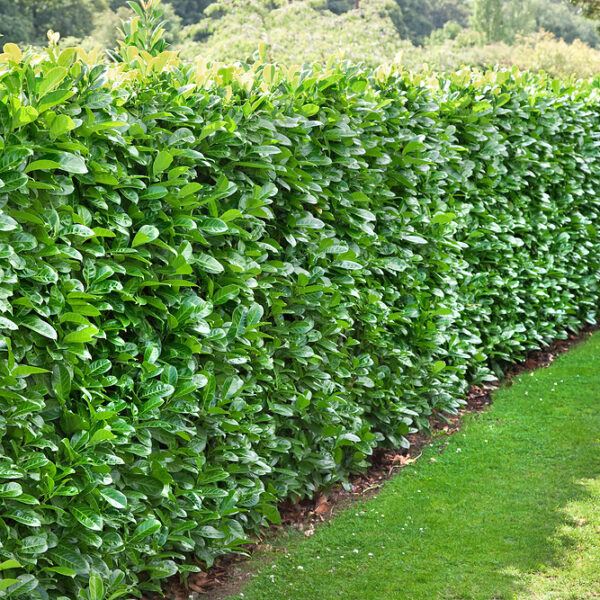
The two main types of laurel plants grown for evergreen hedging in the UK are cherry laurel (Prunus laurocerasus) and Portuguese laurel (Prunus lusitanica). Cherry laurel has large, glossy, broad leaves on vigorous shoots. Portuguese laurel has smaller, more pointed leaves with reddish leaf stalks and young stems, giving a finer texture when clipped.
Both keep their foliage through winter and respond well to clipping. Cherry laurel develops broad, leafy growth that suits taller, wider screens. Portuguese laurel has a finer outline and is generally easier to maintain where the planting strip is narrow. The available space and finished hedge height are useful starting points when choosing. Other plants sometimes called laurel, such as spotted laurel (Aucuba) or bay laurel (Laurus nobilis), are not part of the Prunus group and have different growth habits and garden uses.
- Cherry laurel (Prunus laurocerasus): large glossy leaves, vigorous, good for tall screening.
- Portuguese laurel (Prunus lusitanica): smaller pointed leaves, reddish stems, finer clipped finish.
- Bay laurel (Laurus nobilis): culinary herb, slower growing, not a hedging staple.
- Spotted laurel (Aucuba japonica): unrelated shrub with spotted leaves, used for shady spots.
Cherry and Portuguese laurel compared
Both species can be maintained at around 1.2m or allowed to grow much taller, although an unclipped plant may eventually exceed 5m. Cherry laurel spreads more broadly, while Portuguese laurel tends to form a tighter outline. The comparison below covers leaf size, growth rate, hardiness and the features that affect everyday maintenance.
| Feature | Cherry laurel (Prunus laurocerasus) | Portuguese laurel (Prunus lusitanica) |
|---|---|---|
| Leaf size and shape | Large, broad, glossy leaves up to 15cm long | Smaller, more pointed leaves, typically 6 to 12cm long |
| Stem colour | Green stems | Reddish leaf stalks and young stems |
| Growth rate | 30 to 60cm per year in good conditions | 20 to 45cm per year, slightly slower than cherry laurel |
| Eventual height as a hedge | 1.5 to 5m, can be kept lower with regular trimming | 1.2 to 5m, suits a more formal clipped shape |
| Hardiness | Fully hardy in most of the UK (H5) | Fully hardy in most of the UK (H4 to H5), may need shelter in very cold exposed sites |
| Flowers and fruit | Small white flower spikes in spring, followed by small black fruits | Slender white flower racemes in early summer, followed by small dark purple fruits |
| Toxicity | Leaves and fruits contain compounds that are toxic if eaten | Leaves and fruits contain compounds that are toxic if eaten |
How many laurel plants per metre?
Spacing depends on the starting size of the plants and how quickly you want a dense screen. Smaller plants are often set closer together, while larger pot-grown stock can be spaced a little wider. The table below gives a practical guide for single-row planting.
For a thicker hedge, plant a staggered double row. Add roughly 50 per cent more plants for a double row over the same length. Always check the recommended spacing for the size you order.
| Supplied height | Plants per metre (single row) | Plants for 5m | Plants for 10m | Plants for 20m |
|---|---|---|---|---|
| 40 to 60cm (9cm pot) | 3 to 4 | 15 to 20 | 30 to 40 | 60 to 80 |
| 60 to 90cm (2 litre pot) | 2 to 3 | 10 to 15 | 20 to 30 | 40 to 60 |
| 90 to 120cm (2 litre pot) | 2 | 10 | 20 | 40 |
Is Portuguese laurel good for a hedge?
Portuguese laurel works particularly well for a clipped evergreen boundary. The pointed leaves, reddish leaf stalks and slender young shoots give it a finer appearance than cherry laurel. Because the leaves are smaller, trimming with shears or a hedge trimmer leaves fewer conspicuous cut edges. It responds well to regular pruning and can be kept as low as 1.2m or allowed to reach 4m or more.
Because Portuguese laurel grows a little more slowly than cherry laurel, it may need one trim a year rather than two once the hedge is at the desired size. This can make it a lower-maintenance option for gardeners who want a neat evergreen boundary without frequent cutting. It also tolerates chalky soils better than cherry laurel, though it still prefers a well-drained, moisture-retentive loam.
What are the disadvantages of Portuguese laurel?
Portuguese laurel has a slower growth rate than cherry laurel, so smaller plants take longer to meet along a new boundary. That can be useful once the hedge reaches its intended size, but less convenient if you need screening quickly. It is slightly less vigorous than cherry laurel, so it takes longer to fill out a new hedge if you start with smaller plants. In very cold, exposed gardens, especially in northern or upland areas, young growth can be nipped by late frosts.
The leaves and fruits are toxic if eaten, so it is not suitable where livestock graze close to the hedge. Like all evergreen hedges, it drops older leaves, usually in summer, and this natural shedding can look untidy for a short period. On shallow, dry soils, growth may be thin unless you water during the first two summers after planting.
How fast does Portuguese laurel grow?
Portuguese laurel typically grows 20 to 45cm per year once established. The exact rate depends on soil, moisture, light and how well the ground was prepared before planting. In the first year after planting, growth is often slower while the roots settle in.
Cherry laurel is faster, often putting on 30 to 60cm a year in good conditions. If you need quick screening, cherry laurel will usually give you a dense hedge sooner. Portuguese laurel produces a tighter network of small leaves and slender shoots, which gives a clipped hedge a finer surface. Its slower growth also means that an established hedge may need only one main trim each year.
Planting and aftercare for laurel hedges
Both types of laurel are easiest to establish in autumn or spring, when the soil is moist but not waterlogged. All the cherry laurel and Portuguese laurel sizes in our range are pot-grown, supplied in 9cm or 2 litre pots. They can be planted throughout the year when the ground is workable, although summer planting requires closer attention to watering. Bare root laurel is not among the options listed in our range.
Prepare the ground by clearing weeds and digging in well-rotted organic matter. Set plants at the spacing recommended for the size you have chosen. Water thoroughly after planting and mulch with bark or compost to keep moisture in and weeds down. During dry spells in the first two summers, water deeply once or twice a week rather than little and often.
- Clear weeds and improve the soil with organic matter before planting.
- Set plants at the correct spacing for the supplied height and pot size.
- Water in well and apply a 5 to 7cm mulch layer, keeping it clear of the stems.
- Water regularly during dry weather for the first two growing seasons.
- Feed with a general-purpose slow-release fertiliser in early spring.
Pruning and shaping laurel hedges
Prune cherry laurel in late spring or early summer, after the risk of frost has passed. If you use shears on the large leaves, you will cut through them and leave brown edges. For a cleaner finish, use secateurs to cut individual shoots back to a leaf joint. This takes longer but keeps the foliage looking fresh.
Portuguese laurel can be trimmed with shears or a hedge trimmer because its smaller leaves are less likely to show cut marks. Trim in late spring or after flowering in early summer. Always check for nesting birds before you start. A slight taper, with the base wider than the top, allows light to reach the lower branches and keeps the hedge dense from top to bottom.
Laurel hedge care calendar
Laurel care changes through the year. Spring is useful for feeding and checking new growth, while early summer is the main pruning period. Autumn offers another opportunity to plant pot-grown stock. Adjust the tasks below to local weather, especially during late frosts or prolonged dry spells.
| Month | Task |
|---|---|
| January to February | Plan new hedges. Order plants for late winter or spring delivery. Check existing hedges for wind damage. |
| March | Plant container-grown laurel. Feed established hedges with a balanced slow-release fertiliser. Mulch if not done in autumn. |
| April to May | Water new plants in dry spells. Check for aphids on young shoots. Lightly trim Portuguese laurel if needed after frost risk passes. |
| June to July | Prune cherry laurel with secateurs for a tidy finish. Trim Portuguese laurel after flowering. Water deeply in dry weather. |
| August to September | Give a light trim if needed, but avoid heavy pruning late in the season. Keep watering young hedges during drought. |
| October to November | Plant container-grown or bare root plants (bare root from November). Clear fallen leaves from the base of the hedge. |
| December | Check tree ties and stakes. Avoid walking on waterlogged soil near the hedge. Order bare root plants for planting when conditions allow. |
Choosing the right size and root type
We supply cherry laurel in three pot-grown heights: 40 to 60cm in a 9cm pot, 60 to 90cm in a 2 litre pot and 90 to 120cm in a 2 litre pot. Portuguese laurel is available as 40 to 60cm in a 9cm pot and 60 to 90cm in a 2 litre pot. Smaller plants are economical for long boundaries, while larger plants give more immediate impact.
All these are container grown, so they can be planted at any time of year with good aftercare. Check the quantity you need against the spacing guide and remember that a 2 litre pot plant will have a more developed root system than a 9cm pot plant of the same species.
Common questions
Is Portuguese laurel the same as cherry laurel?
No, they are different species. Cherry laurel is Prunus laurocerasus, with large glossy leaves. Portuguese laurel is Prunus lusitanica, with smaller, more pointed leaves and reddish stems. Both are evergreen and belong to the Prunus genus, but their appearance and growth habits are distinct.
What are the disadvantages of Portuguese laurel?
Portuguese laurel grows more slowly than cherry laurel, so a new hedge takes longer to fill out. Young growth can be damaged by late frosts in very exposed sites. The leaves and fruits are toxic if eaten, so it is not suitable where livestock graze. It also sheds older leaves in summer, which can look untidy for a short while.
Is Portuguese laurel good for a hedge?
Yes, Portuguese laurel makes an excellent formal or semi-formal hedge. Its smaller leaves and reddish new growth give a finer texture than cherry laurel. It responds well to clipping, can be kept from 1.2m upwards, and needs only one trim a year once established. It tolerates chalky soils better than cherry laurel.
How fast does Portuguese laurel grow?
Portuguese laurel typically grows 20 to 45cm per year once established. Growth is slower in the first year while roots settle. Cherry laurel is faster at 30 to 60cm per year. For quick screening, cherry laurel fills out sooner, but Portuguese laurel gives a more refined hedge with less frequent trimming.
Do laurel hedges stay green in winter?
Both cherry and Portuguese laurel are evergreen, so they keep their leaves through winter. Old leaves are shed naturally, usually in summer, and this can cause some temporary thinning. Poor drainage, drought or very cold winds can also cause leaf drop, but a healthy hedge stays green year-round.
Are laurel leaves toxic?
Yes, the leaves and fruits of both cherry laurel and Portuguese laurel contain compounds that are toxic if eaten. Keep clippings away from pets and livestock, and do not use the foliage in cooking. The plants are safe to handle, but wash hands after pruning.
When is the best time to plant laurel hedging?
Our cherry laurel and Portuguese laurel plants are all supplied in pots and can be planted throughout the year when the soil is neither frozen nor waterlogged. Autumn and early spring usually offer the best balance of soil moisture and moderate temperatures. During summer, water deeply whenever the soil around the rootball begins to dry. We do not list bare root laurel among the available sizes.
How many laurel plants do I need for my hedge?
For a single row, space 40 to 60cm plants 3 to 4 per metre, 60 to 90cm plants 2 to 3 per metre, and 90 to 120cm plants 2 per metre. For a 5m hedge, you would need roughly 15 to 20, 10 to 15, or 10 plants respectively. A staggered double row needs about 50 per cent more plants.