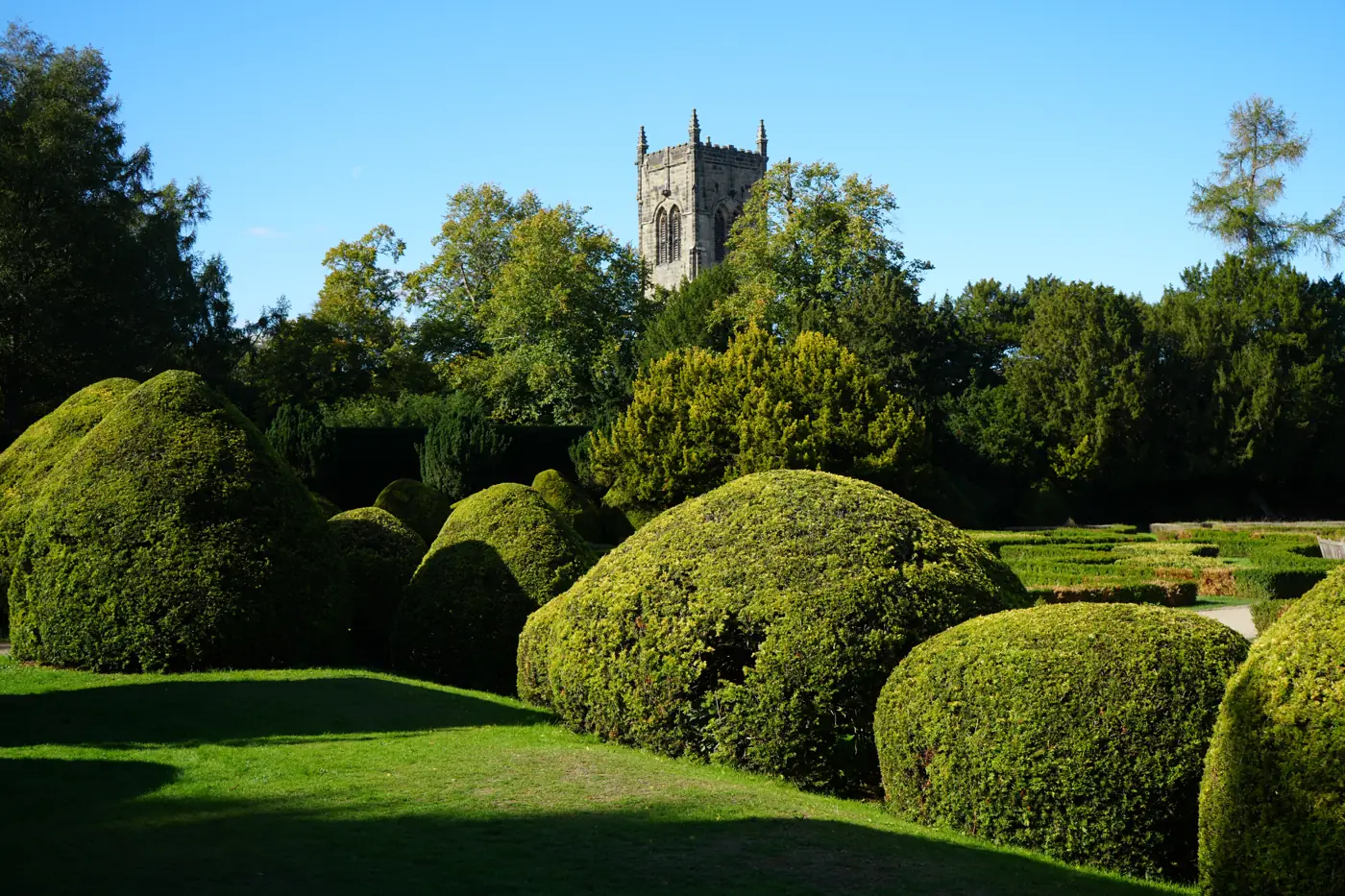
What is so special about yew trees?
Some of Britain's oldest living trees are yews. Ancient specimens still grow in churchyards, with several believed to be over 1,000 years old. Taxus baccata is one of Britain's three native conifers, recognised by its flat, dark green needles and reddish brown bark. In gardens, that remarkable lifespan makes yew particularly useful for permanent boundaries, where a properly maintained hedge can remain in place for generations.
What makes yew truly special for gardeners is its response to pruning. Unlike most conifers, yew breaks readily from old, bare wood. That means you can renovate a neglected hedge, reduce its height or width drastically, and still get fresh green shoots. It also clips into the crispest formal lines of any evergreen, which is why it remains the first choice for topiary and parterres.
The closely packed branches give blackbirds, thrushes and other garden birds somewhere sheltered to nest and roost. Female yews produce fleshy red arils in autumn, which birds eat and help disperse. Yew also supports specialist insects, including the yew tortrix moth. Older trees develop crevices and cavities that can provide shelter for invertebrates and, where suitable, roosting bats.
- Lives for hundreds, sometimes thousands of years
- Regenerates from old wood after hard pruning
- Clips into sharp formal shapes or soft natural forms
- Provides dense shelter and autumn bird food
Why do they call the yew tree the tree of death?
The yew’s association with death is ancient and layered. In pre-Christian Britain, it was a sacred tree linked to immortality and rebirth, but its toxicity and dark, evergreen presence made it a natural symbol for the afterlife. Early churches were often built beside existing yews, and the tradition of planting yews in graveyards continued for centuries, partly as a symbolic guardian, partly because the poisonous foliage deterred livestock from straying onto burial ground.
Practically, the wood was valued for making longbows, a weapon that brought death on the battlefield. The combination of churchyard presence, lethal chemistry and military use cemented the yew’s sombre reputation. In gardens today, the poisoning risk needs careful consideration, particularly where young children, pets or grazing animals may reach the foliage, seeds or discarded clippings. Yew should never be planted within reach of livestock.
How poisonous is yew to humans?
Yew is extremely poisonous. Every part of the plant is toxic except the fleshy red aril that surrounds the seed, and even then, the hard seed inside that aril is poisonous and should never be chewed or swallowed. The needles, bark, wood and roots contain taxine alkaloids, which can cause cardiac arrest if ingested. Symptoms can appear within hours and include dizziness, dry mouth, vomiting and an irregular heartbeat.
For gardeners, the risk is largely through accidental ingestion. Children should be taught never to put any part of a yew in their mouths, and pets must be kept away from clippings. Always wear gloves when pruning, and wash hands thoroughly afterwards. If you suspect someone has eaten any yew material, seek urgent medical attention, do not wait for symptoms to develop.
- All parts toxic except the red aril flesh
- Seed inside the aril is poisonous if chewed
- Taxine alkaloids affect the heart
- Seek immediate medical help if ingested
Shop the plants in this guide
Our English yew hedging plants come in four sizes and root types: 20-40cm potted, 40-60cm bare root, 60-80cm rootball and 80-100cm rootball, each sold as an individual plant. Smaller plants are useful for establishing a hedge gradually, while the taller rootballed options provide greater height from planting. All will need time to grow together into a continuous screen.
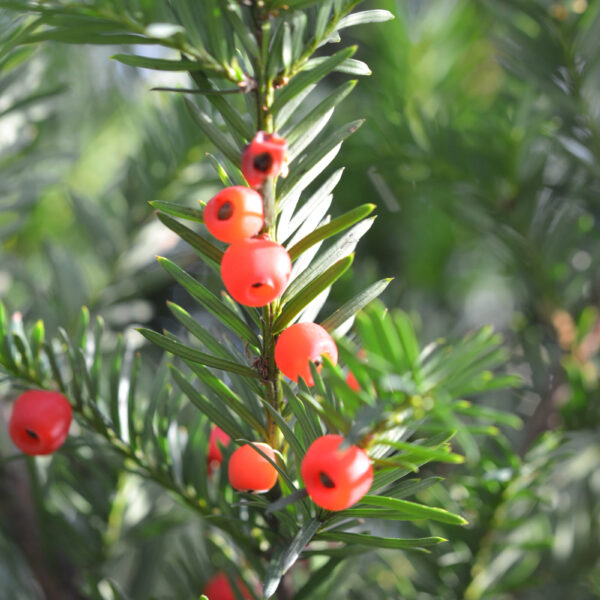
Is it safe to have a yew tree in your garden?
Yes, with sensible precautions. Millions of UK gardens contain yew hedges or specimen trees without incident. The poison is not absorbed through skin, so handling the plant with gloves is safe. The main risks are ingestion and leaving clippings where pets or livestock can access them. If you have free ranging chickens, rabbits or grazing animals, keep them away from yew entirely, it is deadly to horses, cattle and sheep even in small quantities.
The bright red arils can attract the attention of young children, and each contains a highly poisonous seed. Supervise children around fruiting plants and clear fallen arils from accessible areas. A male cultivar will not produce arils, although the English yew hedging plants in this range are not offered as a separately identified male selection. Regular clipping can reduce fruiting, but never assume a trimmed hedge is free of poisonous seeds.
Yew tree identification and types for UK gardens
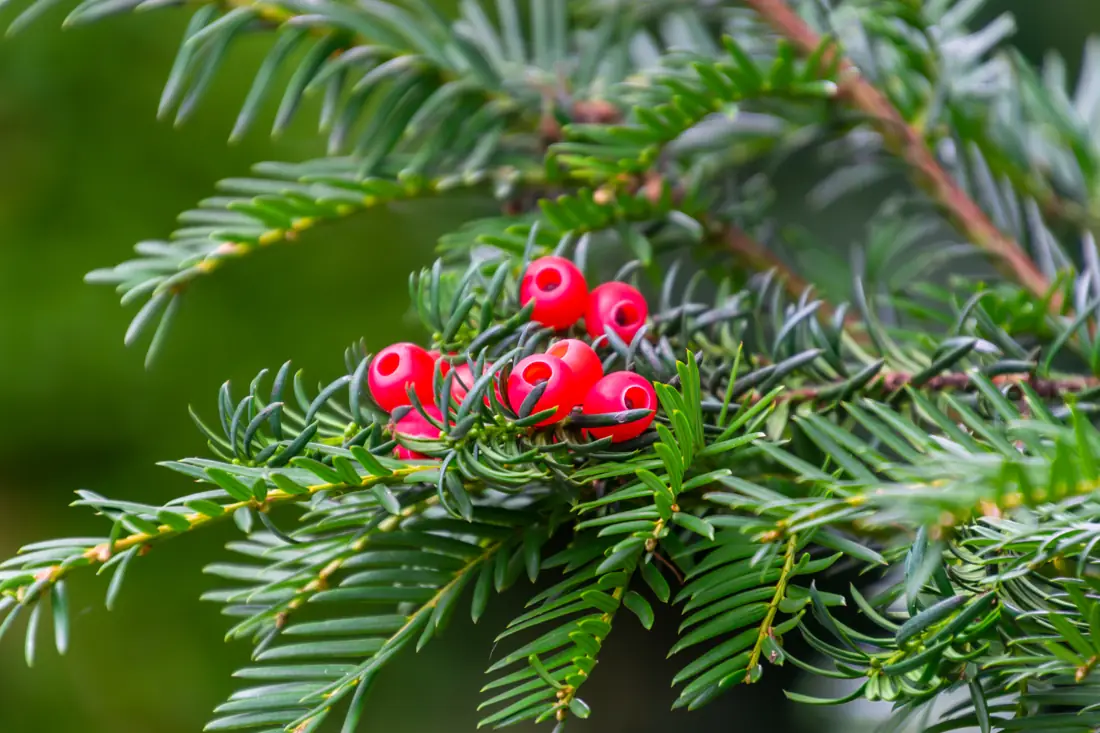
The English yew, Taxus baccata, is the species you will most often see in old churchyards and as hedging. It has dark green, flat needles arranged in two ranks along the twigs, with a paler underside. The bark is reddish brown and flakes in patches. Female trees produce bright red, cup shaped arils in autumn, each containing a single hard seed.
For a traditional evergreen hedge, Taxus baccata is the usual choice. Its densely branching stems respond well to clipping, and established plants can recover even when cut back into older wood. Other forms are useful to recognise, although they are not part of our listed English yew hedging range. Irish yew, Taxus baccata 'Fastigiata', grows naturally into a narrow upright column. 'Repandens' spreads close to the ground, while golden forms such as 'Elegantissima' have yellow-green foliage. These have different growth habits, so ordinary English yew remains the straightforward option for a continuous clipped boundary.
- Taxus baccata: native English yew, ideal for hedging
- Irish yew (Fastigiata): upright, columnar, not for hedging
- Golden forms: slower, suited to specimens or short hedges
Where to plant a yew hedge: soil, sun and spacing
Yew is remarkably adaptable but performs best in well drained soil that does not waterlog. It tolerates full sun to deep shade, though growth is slower in heavy shade. Avoid planting in consistently waterlogged ground, if your soil is heavy clay, improve drainage with grit and organic matter before planting, or consider a slightly raised planting line.
The ideal pH is neutral to alkaline, but yew copes with mildly acidic soils. Unlike many conifers, it thrives on chalk. Wind exposure is rarely a problem once established, though young plants benefit from shelter in very exposed coastal or upland sites. Yew also tolerates urban pollution, making it a reliable choice for town gardens.
- Well drained soil essential, avoid waterlogging
- Full sun to deep shade; slower in shade
- Thrives on chalk and alkaline soils
- Tolerates wind and urban pollution once established
When to plant a yew hedge
The planting window depends on the root type. Bare root yew plants are only available during the dormant season, from November to March, and this is the most economical way to establish a hedge. Plant as soon as possible after delivery, ideally on a mild day when the ground is not frozen or waterlogged.
Rootballed yew, plants lifted with a ball of soil wrapped in hessian, are also planted in the dormant season, typically from October to April. Potted yew can be planted at any time of year, provided the ground is workable. If planting in summer, water thoroughly and regularly until the hedge is established.
- Bare root: November to March
- Rootball: October to April
- Potted: year round when ground is workable
How to plant a yew hedge step by step
Good preparation is the foundation of a long lived yew hedge. Take your time with soil improvement and planting depth, yew hates being planted too deep. Follow these steps for the best results.
- 1. Mark the line of your hedge with string and canes. For a straight hedge, use a taut line; for curves, lay a hose to guide you.
- 2. Clear all weeds and grass from a strip at least 60 cm wide. Perennial weeds like bindweed and couch grass must be removed completely.
- 3. Dig a trench roughly 40 cm wide and 40 cm deep. Fork over the base to break up any compaction.
- 4. Improve the excavated soil by mixing in well rotted garden compost or leaf mould. On heavy clay, add horticultural grit. Do not add manure or fertiliser directly into the planting trench.
- 5. For bare root plants, soak the roots in a bucket of water for an hour before planting. For rootballed plants, leave the hessian wrap in place, it will rot away, but remove any plastic netting. For potted plants, gently tease out the roots if they are circling the pot.
- 6. Set each plant in the trench at the same depth it was growing before, look for the soil mark on the stem. Planting too deep is a common cause of failure.
- 7. Backfill around the roots, firming gently with your heel as you go. Avoid heavy stamping, which compacts the soil.
- 8. Water thoroughly, even if rain is forecast. This settles the soil around the roots.
- 9. Apply a 5 cm layer of mulch, such as bark chips or leaf mould, keeping it clear of the stems.
Yew hedge spacing and sizing: how many plants per metre
Spacing depends on the size of the plants you start with and how quickly you want a dense screen. The table below gives recommended planting distances for typical yew hedging sizes. Closer spacing gives faster coverage but requires more plants. Wider spacing saves money but takes longer to fill in.
As a rule, yew is slower than plants like laurel or Leylandii, so it is worth planting at the closer end of the range if your budget allows. At 3 plants per metre, young yews have relatively little distance to grow before neighbouring branches meet. A wider planting distance leaves larger gaps to fill. Allow several growing seasons for a continuous hedge, with the time depending on starting height, soil conditions, watering and the amount of shade.
| Plant size | Root type | Plants per metre | Final hedge height |
|---|---|---|---|
| 20-40 cm | Potted | 4 to 5 | 1 to 3 m |
| 40-60 cm | Bare root | 3 to 4 | 1.5 to 4 m |
| 60-80 cm | Rootball | 2.5 to 3 | 2 to 5 m |
| 80-100 cm | Rootball | 2 to 2.5 | 2.5 to 6 m |
Watering and feeding yew hedges
Newly planted yew needs consistent moisture for the first two growing seasons. Water deeply once a week during dry spells, giving roughly 10 litres per plant. Little and often is less effective than a thorough soak that reaches the rootball. In winter, watering is rarely needed unless the soil is exceptionally dry.
Once established, yew is drought tolerant and needs no routine watering except in prolonged hot, dry weather. Feeding is similarly low maintenance. Apply a balanced, slow release fertiliser such as blood, fish and bone in early spring, at about 70 g per square metre. A mulch of well rotted compost each autumn feeds the soil and conserves moisture. Avoid high nitrogen feeds, which encourage soft, sappy growth that is vulnerable to frost and disease.
- Water new plants deeply once a week in dry weather
- Established hedges need water only in prolonged drought
- Feed with blood, fish and bone in early spring
- Mulch annually with compost or leaf mould
When to cut a yew hedge: month by month pruning guide
When cutting a yew hedge, aim for a slight batter, the top slightly narrower than the base, so light reaches the lower branches. Yew tolerates hard renovation pruning back into old wood, but do this in stages over two or three winters to avoid shocking the plant.
| Month | Pruning task |
|---|---|
| January | No cutting. Check for storm damage and tie in any loose branches. |
| February | No cutting. Finish any winter structural pruning on mature hedges. |
| March | Light tidy of stray shoots if essential, but better to wait. |
| April | Avoid cutting; birds are nesting. Check for pests on new growth. |
| May | No cutting. New growth is soft and vulnerable to scorch. |
| June | Possible first light trim on very formal hedges, after bird nesting checks. |
| July | Main trim window opens. Ideal for a single annual cut. |
| August | Prime month for the main cut. Growth slows after trimming. |
| September | Last safe month for a main cut. Allows time to harden before frost. |
| October | Emergency tidy only. Avoid heavy cutting that exposes soft wood. |
| November | No cutting. Rake up fallen needles and arils. |
| December | No cutting. Check ties and stakes after gales. |
Common yew hedge problems and fixes
Yew is generally trouble free, but a few issues can arise. The most common is yellowing foliage, which is usually a sign of waterlogging or planting too deep. Check drainage and, if necessary, lift and replant at the correct depth. Pale new growth can indicate nutrient deficiency, a spring feed usually corrects it.
Pests are rare. Yew scale can occasionally appear as small brown bumps on stems; a winter wash with plant oil based sprays controls it. Vine weevil larvae may attack roots in light soils, particularly in pots. Root rot (Phytophthora) is the most serious disease, causing dieback and blackened roots. There is no cure, so prevention through good drainage is essential.
Brown patches after winter are often wind scorch rather than disease. Trim out affected shoots in spring and the plant usually recovers. If a whole plant dies suddenly, suspect root damage from waterlogging or physical injury.
- Yellow leaves: check drainage and planting depth
- Pale growth: feed with balanced fertiliser in spring
- Yew scale: treat with winter plant oil wash
- Root rot: avoid waterlogged soil, no chemical cure
- Wind scorch: trim brown shoots in spring
Yew hedge design ideas for UK gardens
A yew hedge is the ultimate structural plant. Use it to create formal garden rooms, frame a view or underplant with perennials for a classic English border. Low yew hedges, kept at 60 to 90 cm, make excellent edging for paths and vegetable gardens, a durable alternative to box.
For privacy, a yew hedge at 1.8 to 2.5 m gives year round screening without the bulk of Leylandii. It also makes a superb backdrop for roses and herbaceous plants, the dark green setting off flower colours. Yew balls and cones in pots bring evergreen structure to terraces and doorways, and can be clipped to keep their shape for decades.
In larger gardens, consider a yew avenue or a staggered double row for a thicker, more wildlife friendly boundary. Mixed native hedging with yew, holly and hawthorn gives a tapestry effect that changes through the seasons.
- Low formal edging at 60 to 90 cm
- Privacy screens at 1.8 to 2.5 m
- Backdrop for roses and perennials
- Clipped balls and cones in pots
- Mixed native hedge with holly and hawthorn
Yew hedge maintenance calendar: seasonal tasks for a healthy hedge
A well planned maintenance routine keeps yew hedges dense, dark green and structurally sound for decades. English yew hedging plants are forgiving but they respond best when key jobs happen at the right time of year. This seasonal calendar covers feeding, mulching, watering and health checks for established yew hedges, not the first year after planting which needs more frequent attention.
January to February marks the quietest period. With yew hedge plants dormant, use frost free days to remove any dead, diseased or crossing branches. Check ties on newly planted yew hedging plants and firm back any lifted by frost. If you ordered bare root yew hedging for late winter planting, store bundles in a sheltered spot with roots covered by damp compost until the ground is workable.
March to April brings the first flush of growth. Apply a balanced slow release fertiliser around the root zone of your yew taxus hedge, following packet rates. A 5 cm to 7 cm layer of well rotted organic mulch, kept clear of the stems, conserves moisture and suppresses weeds. This is also the window for planting potted english yew hedging plants, giving roots a full season to settle before summer heat.
May to June demands consistent watering for yews for hedges planted in the last two years. Deep soak once a week during dry spells rather than light daily sprinklings. Check for signs of stress on yew tree hedge specimens such as pale foliage or needle drop. Hand pull weeds close to stems to avoid root damage from hoeing.
July to August is the main pruning season. Trim english yew hedging in late summer, ideally August, so new growth has time to harden slightly before autumn. Use sharp shears and cut on a slightly cloudy day to reduce scorch on freshly exposed inner leaves. Collect clippings promptly because dried yew foliage remains toxic to livestock.
September is generally the last opportunity to give a formal yew hedge a light finishing trim before colder weather. Avoid unnecessary cutting once temperatures fall, especially where fresh growth may be vulnerable to frost. There is usually no need to feed established yew in autumn; concentrate on keeping the soil mulched and free of competing weeds. Late summer and early autumn are also suitable for taking semi-ripe Taxus baccata cuttings, using healthy shoots from the current season.
November to December signals the start of bare root planting season. Established yew hedging plants need little attention beyond clearing fallen leaves from the base to prevent fungal issues. If heavy snow is forecast, gently brush accumulations off the top of yew hedges to prevent splaying. This quiet season is perfect for ordering yew trees for sale as bare root stock for the most economical way to extend a hedge.
Yew topiary shapes and care: from yew balls to formal cones
English yew is particularly well suited to topiary because its short needles and closely spaced branches produce a smooth surface when clipped. It also makes fresh growth from older wood, allowing established shapes to be corrected if they become uneven. Ordinary Taxus baccata can be trained into balls, cones and pyramids, while the naturally upright Irish yew is often used for narrow columns. Our listed yew plants are Taxus baccata hedging stock rather than ready-shaped topiary or separately offered Irish yew cultivars.
Yew balls are the most popular entry point into topiary. Start with young bushy yew plants in pots or plant directly into the ground. For a 40 cm sphere, choose a plant with several strong stems and plenty of low branching. Use a wire former or a homemade template cut from plywood to guide early shaping. The first trim sets the silhouette; clip lightly two or three times in the first two years to encourage dense branching inside the form. Once the basic globe is filled in, a single annual trim in August maintains the outline. Always work from the top down and rotate around the plant to avoid flat spots.
Cones and pyramids suit the upright habit of taxus irish yew particularly well. The naturally fastigiate shape of Irish yew reduces the amount of corrective pruning needed. Set a central cane at planting time and tie the leader loosely. Use three or four canes angled inwards to create a framework, then trim to the guides each summer. For a broader cone using Taxus baccata, allow the plant to reach the desired height before restricting the tip, then shape the sides to a smooth taper. The key is patience; rushing the height before the base has filled out leads to a top heavy form that looks unbalanced.
Spirals and more complex forms require a well furnished plant with a clear central stem. Start shaping when the yew is about 1 m tall. Mark the spiral path with wide tape or garden twine wound around the plant, then carefully clip away foliage between the bands to reveal the trunk. Deepen the cuts gradually over two or three seasons to avoid exposing large bare patches. Yew for hedging that has been grown as a bushy specimen from the start gives the best raw material.
Aftercare for all yew topiary mirrors that of yew hedging plants. Feed with a balanced fertiliser in spring, mulch to retain moisture and water deeply in dry spells. Watch for woolly aphid hiding in tightly clipped surfaces and treat with a winter wash if needed. Avoid trimming in full sun to prevent leaf scorch on newly exposed inner needles. With steady care, yew topiary becomes a defining feature, linking house and garden with timeless structure.
Buying yew hedge plants: what to look for
When buying yew for hedging, choose plants with healthy, dark green foliage and no signs of yellowing or dieback. Bare root plants should have a well developed, fibrous root system, not a single thick taproot. Rootballed plants should feel heavy for their size, with moist soil and intact wrapping. Potted plants should not be pot bound, if roots are circling densely, tease them out before planting.
Consider the size you need. Smaller plants establish quickly and are cheaper, but take longer to form a hedge. Larger rootballed plants give instant impact and are the best choice if you want a head start on privacy. Our English yew hedging range includes the options below, all grown to suit UK conditions.
Common questions
What is so special about yew trees?
Yew trees are special for their extraordinary longevity, ability to regenerate from old wood after hard pruning, and the dense, dark green foliage that clips into the crispest formal hedges. They are one of Britain’s three native conifers and provide valuable wildlife shelter and food.
How poisonous is yew to humans?
Yew is extremely poisonous. Every part of the plant except the fleshy red aril contains taxine alkaloids that can cause cardiac arrest. The seed inside the aril is also poisonous if chewed. Always wear gloves when handling yew and seek urgent medical help if any part is ingested.
Is it safe to have a yew tree in your garden?
Yes, it is safe with sensible precautions. The poison is not absorbed through skin, so handling with gloves is fine. Keep clippings away from pets and livestock, and supervise young children around fruiting trees. In a regularly trimmed hedge, arils are rarely produced.
Why do they call the yew tree the tree of death?
The yew’s association with death comes from its ancient churchyard presence, its use for making longbows, and its highly poisonous nature. It was planted in graveyards partly to deter livestock and partly as a symbol of immortality and the afterlife.
When to cut yew hedge?
The best time to cut a yew hedge is late summer to early autumn, ideally August or September. This allows new growth to harden before winter. A light trim can also be done in June for very formal hedges, after checking for nesting birds.
When to prune yew hedge?
Prune a yew hedge in late summer, typically August or September, for the main annual cut. Renovation pruning of overgrown hedges is best done in stages over winter, cutting back into old wood gradually to avoid shocking the plant.
When to plant yew hedge?
Plant bare root yew from November to March, rootballed yew from October to April, and potted yew at any time of year when the ground is not frozen or waterlogged. The dormant season gives the best establishment for bare root and rootballed plants.
How fast does a yew hedge grow?
A yew hedge grows at a slow to moderate rate, typically 15 to 30 cm per year once established. It is slower than laurel or Leylandii, but its dense growth and longevity make it a permanent, low maintenance screen.
Can yew be grown in pots?
Yes, yew grows well in large pots with good drainage. Use a loam based compost and feed annually. It is ideal for clipped balls or cones, but needs regular watering in summer. Potted yew is slower growing and may need root pruning every few years.
Does yew need full sun?
No, yew tolerates full sun to deep shade. It grows more slowly in heavy shade, but remains dense and healthy. This makes it one of the best evergreens for north facing walls and dark corners.