Best Small Evergreen Shrubs for Pots
A pot by the front door or on the patio looks less bare in winter when it contains an evergreen shrub. Compact hebes, variegated euonymus and dwarf conifers are useful choices, giving you foliage and shape throughout the year. Choose plants that grow slowly or respond well to light pruning, and allow enough room in the container for healthy root development. Seasonal bedding can be added around the edges where space permits.
When you are choosing evergreen shrubs for pots, look at the eventual height and spread. A shrub that wants to reach 3 metres will quickly outgrow a 40cm container. Stick to varieties that mature at roughly 1 metre or less, or those that respond well to an annual trim. The selection below includes compact shrubs as well as taller conifers and pieris that suit larger containers. Check the eventual height and spread before planting, as some will need repotting or pruning as they mature.
Pay attention to the light your pot will receive. Wilma Goldcrest and many dwarf conifers prefer bright positions, while euonymus tolerates some shade. Hebes generally flower best with plenty of light and a sheltered position, particularly in colder gardens. Match the shrub to the spot, and you will have a healthy plant that needs little intervention beyond watering and an occasional feed.
| Shrub | Typical pot size to start | Eventual height in a pot | Light preference |
|---|---|---|---|
| Wilma Goldcrest | 2 litre | 1.2 to 1.5m | Full sun |
| Mixed dwarf conifers | 2 litre or 9cm | 0.5 to 1.2m depending on type | Full sun to light shade |
| Mixed hebes | 2 litre or 9cm | 0.5 to 1m | Full sun to partial shade |
| Euonymus Emerald 'n' Gold | 2 litre or 9cm | 0.5 to 1m | Sun or partial shade |
| Euonymus Emerald Gaiety | 2 litre | 0.5 to 1m | Sun or shade |
| Mixed garden heathers | 9cm | 0.2 to 0.4m | Full sun |
| Dwarf evergreen azalea | 2 litre | 0.6 to 1m | Partial shade |
| Pieris Forest Flame | 2 litre | 1 to 1.5m | Partial shade |
Dwarf Conifers and Wilma Goldcrest
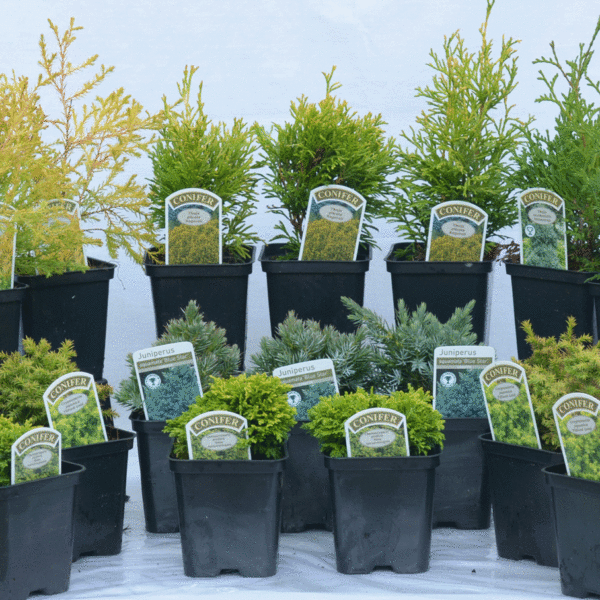
Dwarf conifers are classic evergreens for pots. They grow slowly, keep a neat shape without much pruning, and provide texture through winter. Mixed dwarf conifers can include different growth habits, from low, rounded plants to upright forms. Check the mature height and spread of each plant before arranging them, so the larger growers do not crowd out their neighbours. Our mixed dwarf conifers come in several pack sizes: you can start with four plants in 9cm pots, or choose a set of six in 2 litre pots for a more established look. Larger packs of 12 or 18 potted plants are useful if you want to fill several containers at once.
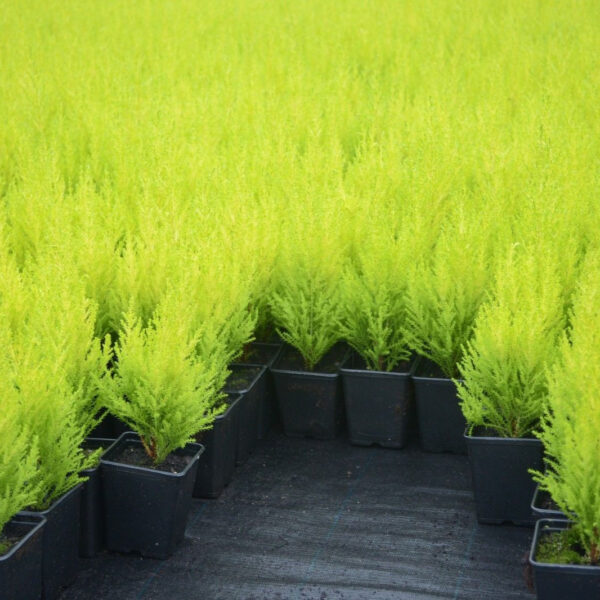
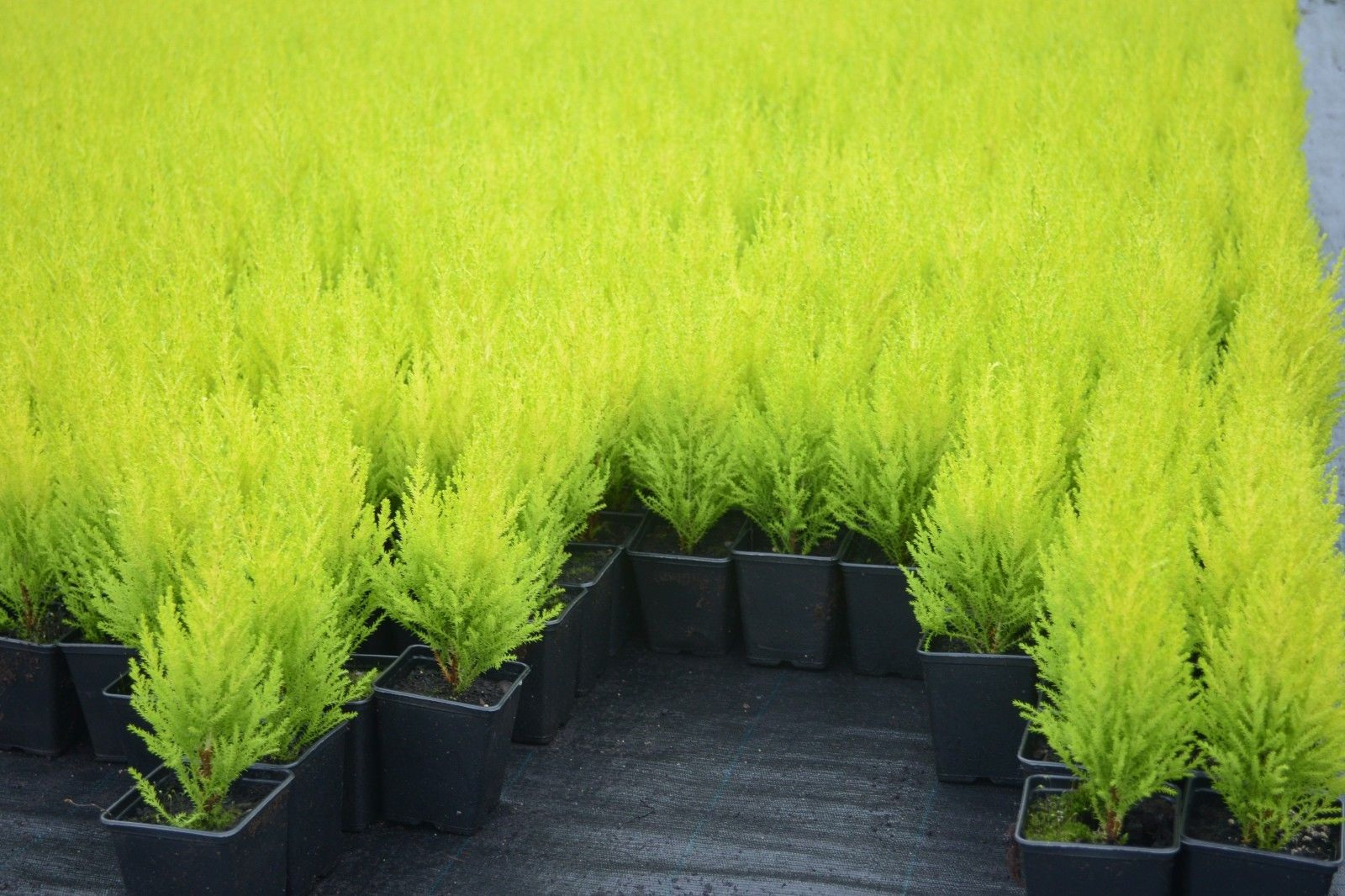
Wilma Goldcrest is a standout conifer for a single specimen pot. Its bright lime-green foliage has a lemony scent when brushed, and its narrow, conical habit makes it a natural focal point. Wilma Goldcrest is available as a single plant in a 2 litre pot. In a larger container it may grow roughly 10 to 20cm a year under suitable conditions, although its eventual height is not limited to 1.5 metres. Allow space for its upright growth and trim lightly if needed. You can also buy Wilma Goldcrest in packs of 6, 12 or 18 smaller plants, which is handy if you want a matching row of pots along a path or balcony.
Both dwarf conifers and Wilma Goldcrest need free-draining compost and a sunny spot. Water them regularly during the first growing season so the roots spread into the new compost. Once established, they are fairly drought-tolerant but will suffer if left to sit in waterlogged soil. A top dressing of gravel helps keep the surface dry around the crown.
Hebes, Heathers and Euonymus
Hebes are some of the most reliable evergreen shrubs for pots, particularly in coastal or milder areas. They have glossy leaves and produce spikes of purple, pink or white flowers in summer. Hebe Red Edge is a compact variety with grey-green foliage that takes on a reddish margin in cold weather, giving you two seasons of interest from one plant. It is sold in 9cm pots, with options for 2, 3, 4 or 6 plants. A group of three planted in a wide, shallow bowl makes a full, mounded display within a year.
Mixed hebes give you a selection of leaf colours and flower shades, all with the same easy-care habit. They are available as 4 plants in 2 litre or 9cm pots, or in larger packs of 6, 12 or 18 plants in 9cm pots. Space them about 30cm apart in a container for a dense, shrubby planting that flowers from midsummer into autumn.
Euonymus Emerald 'n' Gold and Emerald Gaiety are tough, variegated evergreens that light up a shady corner. Emerald 'n' Gold has green and gold leaves with a pinkish tinge in winter. Emerald Gaiety is green and white, and its trailing habit works well at the edge of a pot. Both are available as single plants in 2 litre pots, and Emerald 'n' Gold also comes in a 9cm pot. They grow about 10 to 15cm a year and can be clipped lightly in spring to keep them bushy.
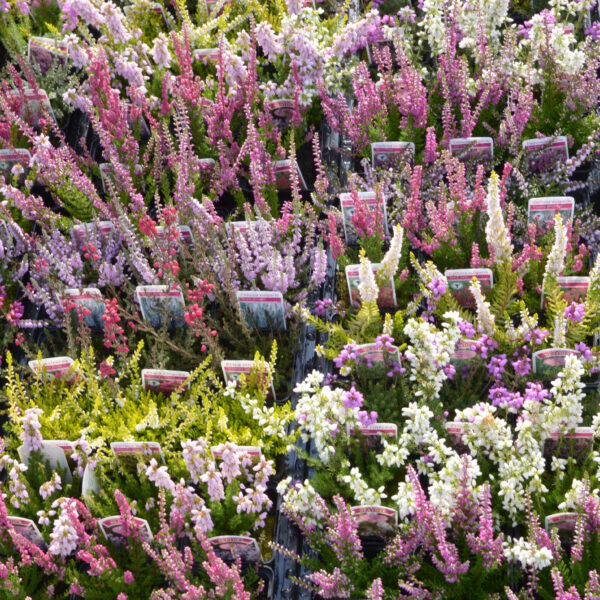
Mixed garden heathers bring low evergreen foliage and small flowers to containers. Packs contain 6, 12 or 18 plants in 9cm pots, giving you enough for several individual pots or a wider trough. Flowering times depend on the varieties included, so colour may appear at different points in the year. Most heathers prefer a sunny position, but check the species before choosing compost, as some tolerate lime while others require acidic conditions. Trim lightly after flowering without cutting into old, bare wood.
Ericaceous Shrubs in Pots
Several small evergreen shrubs need acidic soil, which makes them perfect candidates for pots. You can give them exactly the ericaceous compost they require without trying to alter your garden soil. Dwarf evergreen azaleas, mixed Japanese azaleas, mixed dwarf rhododendrons, Pieris Forest Flame and Pieris Mountain Fire all fall into this group.
Dwarf evergreen azaleas are sold as single plants in 2 litre pots, in a choice of colours. They form neat, rounded bushes covered in flowers in late spring. Mixed Japanese azaleas are available as 4 plants in 9cm pots, or as 4 or 6 plants in 2 litre pots. They are slightly more compact and often flower a little earlier. Both types keep their leaves through winter, though some may take on bronze tones in cold weather.
Mixed dwarf rhododendrons give you larger leaves and trusses of bell-shaped flowers in spring. You can buy them in 9cm pots (packs of 6, 12 or 18) or in 2 litre pots (packs of 3, 4 or 6). They are slow-growing and will live happily in a pot for many years if you repot them every two to three years into fresh ericaceous compost.
Pieris Forest Flame and Pieris Mountain Fire are grown for their dramatic new growth. Forest Flame produces bright red young leaves that fade to pink, cream and then green. Mountain Fire has coppery-red new shoots. Pieris Mountain Fire is available as a single plant in a 2 litre pot. Pieris Forest Flame is also available as a single 2 litre plant, alongside options for 6, 12 or 18 plants and a separate pack of 6 plants in 2 litre pots. The pot or root specification for the other Forest Flame multipacks is not stated in the catalogue. They like partial shade and shelter from cold winds, which makes a pot in a courtyard or against a wall ideal.
Pot Size, Compost and Watering
Choosing the right pot and compost is as important as choosing the shrub itself. A container that is too small will restrict roots and dry out quickly. A pot that is too large can hold too much wet compost in winter, leading to root rot. As a rule, start a young shrub in a pot that is 5 to 8cm wider than the nursery pot it arrives in. Move it up a size every two to three years as it grows.
For most small evergreen shrubs, a loam-based compost such as John Innes No 2 is ideal. It holds nutrients well, drains freely and gives the pot some weight, which stops it blowing over. For ericaceous plants (azaleas, rhododendrons, pieris, heathers), switch to an ericaceous John Innes compost. Avoid using garden soil in pots: it compacts, drains poorly and may introduce weeds or diseases.
Watering is the single biggest task with shrubs in pots. In summer, a container can dry out in a day. Check the compost with your finger; if the top 2 to 3cm feels dry, water thoroughly until it runs out of the drainage holes. In winter, reduce watering but never let the compost dry out completely. Evergreens lose water through their leaves even in cold weather, so they still need some moisture at the roots.
Feeding keeps potted shrubs healthy. From March to August, apply a balanced liquid feed every two to four weeks. For ericaceous shrubs, use a feed formulated for acid-loving plants. A controlled-release fertiliser mixed into the compost in spring is a good low-maintenance alternative. Stop feeding by early September so any soft new growth has time to harden before frosts.
| Shrub type | Compost | Feed type | Repotting frequency |
|---|---|---|---|
| Dwarf conifers, Wilma Goldcrest | Loam-based John Innes No 2 | Balanced liquid feed | Every 2 to 3 years |
| Hebes, euonymus | Loam-based John Innes No 2 | Balanced liquid feed | Every 2 years |
| Heathers | Ericaceous John Innes | Ericaceous liquid feed | Every 2 years |
| Azaleas, rhododendrons, pieris | Ericaceous John Innes | Ericaceous liquid feed | Every 2 to 3 years |
Winter Care for Potted Shrubs
Evergreen shrubs in pots face two main winter challenges: frozen roots and wind scorch. The roots are above ground and far more exposed than they would be in a border. A few simple steps will see them through the coldest months.
First, raise the pot onto feet or bricks so excess water can drain away. A pot sitting in a puddle of frozen water can split, and the roots will suffer. Second, wrap the pot with bubble wrap, hessian or a purpose-made pot jacket. This insulates the rootball against sharp temperature swings. Third, group pots together in a sheltered spot, ideally against a house wall, where they benefit from radiated heat and reduced wind.
Snow is not usually a problem for small evergreens, but a heavy fall can splay branches. Knock snow off gently with a broom to prevent breakage. Do not use salt or chemical de-icers near pots, as the run-off can damage roots and foliage.
If a prolonged freeze is forecast and the compost is dry, water sparingly on a mild day. Moist compost holds more heat than dry compost, so a light watering before a freeze can actually protect roots. Avoid feeding in winter, as the plants are not actively growing.
Common questions
What are the best small evergreen shrubs for pots in shade?
Euonymus Emerald Gaiety is one of the best choices for shade, with its white-edged leaves brightening dark corners. Euonymus Emerald 'n' Gold also tolerates partial shade well. Both grow slowly and need little pruning. In a shadier position, Euonymus Emerald Gaiety is a practical choice, although its variegation will generally look brighter with some daylight. Box can also tolerate shade, but the Garden Hedges box hedging option is supplied as 20 to 40cm bare root plants rather than ready-clipped potted specimens.
Can I plant small evergreen shrubs in pots at any time of year?
Pot-grown shrubs can be planted at any time, provided the ground or compost is not frozen or waterlogged. Spring and early autumn are ideal because the roots establish quickly in warm, moist compost. Summer planting is fine as long as you water regularly. Avoid planting during hard frosts or heatwaves, when stress is highest.
How often should I water evergreen shrubs in pots?
In summer, check pots daily. Water thoroughly when the top 2 to 3cm of compost feels dry. In spring and autumn, every two to three days is often enough. In winter, water only when the compost is dry to the touch, which may be once every week or two. Never let pots sit in water-filled saucers for more than an hour.
Do I need to prune small evergreen shrubs in pots?
Most of the shrubs listed need little pruning. Clip hebes lightly after flowering to keep them compact. Trim euonymus in spring to shape. Dwarf conifers rarely need cutting, though you can pinch out the growing tips of Wilma Goldcrest to control height. Remove any dead, damaged or crossing branches whenever you see them.
Which small evergreen shrubs are best for winter pots?
Wilma Goldcrest, dwarf conifers, euonymus and heathers can all provide winter interest in containers. Euonymus retains its variegated leaves, while conifers give structure after summer bedding has finished. Some heathers flower in winter, depending on the varieties included. Keep pots well drained and move less hardy plants into shelter during prolonged frost. For extra winter impact, underplant with winter-flowering pansies or cyclamen, which will finish as the shrubs start their spring growth.
Can I grow lavender in a pot with evergreen shrubs?
French lavender Bandera Purple is an excellent pot subject. It is compact, flowers from late spring into autumn and has aromatic grey-green foliage. Plant it in a terracotta pot with loam-based compost and plenty of grit for drainage. It pairs well with dwarf conifers or hebes, but keep it in full sun and avoid overwatering.
What compost should I use for ericaceous shrubs in pots?
Use a dedicated ericaceous John Innes compost for azaleas, rhododendrons, pieris and heathers. This is loam-based, so it holds nutrients and water better than peat-only mixes. Avoid tap water in hard-water areas if possible; rainwater is ideal. Repot every two to three years into fresh ericaceous compost to maintain the right pH.